The Bowl Under the Microscope: What the Heavy Metals Headlines Really Mean for Your Cat
Headlines say 99% of cat foods contain lead. The calm, evidence-first guide to the Clean Label Project's 2026 report — what it found, what it did not prove, and five royal decrees for a safer bowl, from Biscuit's own kitchen.
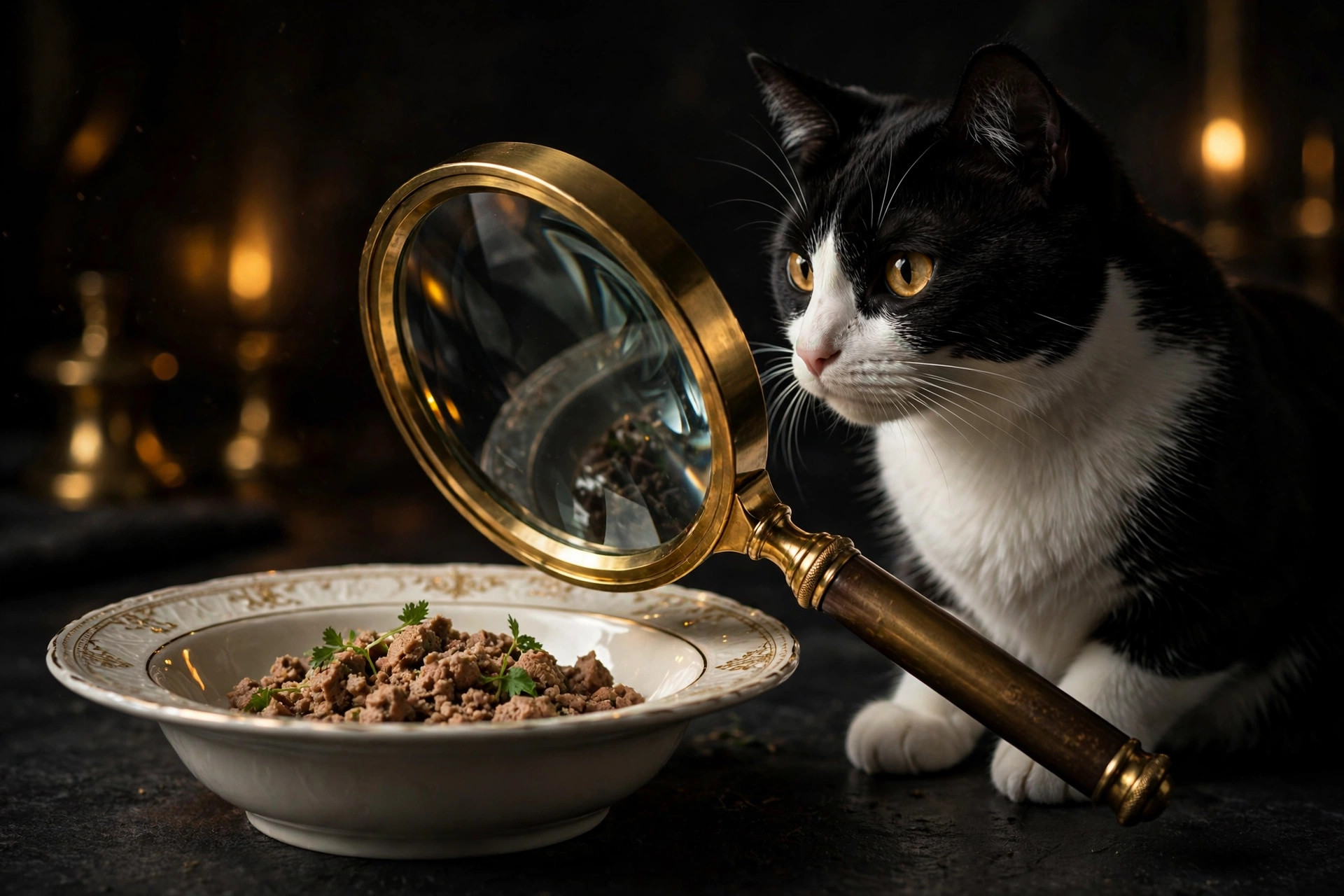
Last week, the headlines arrived like an invading army: lead in 99% of cat foods, mercury, arsenic, plastic chemicals in the bowl. If your group chats looked anything like mine, somebody was already threatening to cook chicken by hand for the rest of their cat's life, and somebody else was declaring all kibble poison.
Biscuit watched the commotion from the top of the stairs with the expression of a king observing a peasant revolt. Then he went downstairs and ate his dinner.
That is more or less the correct response. Panic is beneath royalty — but ignorance is beneath a good steward. So let us do what the headlines rarely do: read the actual report, understand what it proves, admit what it does not, and then make five calm, practical decisions about the bowl.
What the Report Actually Found
On October 2, 2026, the Clean Label Project — a Colorado nonprofit — released its 2026 Cat Food Category Report. It tested 100 top-selling cat foods across 62 brands for more than 122 industrial and environmental contaminants. This was not a government recall and not a single brand exposé; it was a sweep of the whole category, following a similar study of dog food the group released earlier this year.
The numbers that made the headlines:
- Lead was detected in 99% of products, cadmium in 96%, and arsenic in 94%. Note: "detected" means trace amounts found — not "dangerous." Hold that thought; it matters.
- Dry food carried roughly three times more lead than wet or air-dried food, measured per calorie.
- Fish and seafood products carried about 18 times more mercury overall than other-protein foods — and among wet foods, fish-based products had nearly 28 times more mercury than wet foods made with other proteins. Nearly half of all fish and seafood products landed in the highest-mercury group, while not a single poultry-based product did. Fish-based foods also showed about 2.5 times more cadmium.
- Protein source turned out to be the biggest lever. Nearly 85% of poultry-based foods met the group's purity standard, compared with just 25.7% of fish and seafood products.
- DEHP — a plastic chemical linked to cancer and birth defects — appeared in about half the products tested, highest in canned and pouched foods with plastic-lined packaging.
- Glyphosate turned up in 37% of products, higher in foods with plant ingredients near the top of the label.
The group's executive director, Molly Hamilton, said it plainly: "Most cats eat the same foods nearly every day, with little variation. The contaminants are an ongoing exposure that may accumulate in cats' bodies over their lifetimes." Fair point: a cat is a creature of habit eating the same recipe twice a day for a decade — which means even tiny, chronic exposures deserve a serious look.
What the Report Did Not Prove
Here is where the royal court separates signal from noise — four caveats change the picture substantially.
First, detection is not danger. The report was designed to compare contaminant levels between foods, not to determine whether any product can make a cat ill. USA Today, covering the findings, made this explicit: the findings do not mean the tested products are unsafe for cats.
Second, each product was tested from a single batch. Contaminant levels can vary between batches of the same food, and most brands contributed only one product — so the study says little about any individual brand.
Third, concentration numbers need a calorie lens. Dry food is dense; wet food is mostly water. A cat eats far less kibble by volume than wet food for the same calories, which changes the exposure math — a point a veterinary nutritionist made in coverage of the group's earlier dog-food study.
Fourth, "no comprehensive federal limits" cuts both ways. The Pet Food Institute, representing manufacturers, responded that its members run comprehensive food safety and quality assurance programs, and that owners "should feel confident" in the safety of pet food. Safety thresholds for animal feed are set by AAFCO and the National Research Council — so "unregulated" is not the same as "lawless." The gap the report highlights is about long-term, low-level contaminants, not basic safety oversight.
In short: the report is a flashlight, not a fire alarm. It reveals something real — contamination varies enormously by protein and format, and some of it is avoidable — without proving anyone's dinner is poison.
Five Royal Decrees for a Safer Bowl
So what does a clear-eyed steward do? Not burn the pantry. These five moves follow directly from the evidence:
1. Make fish a treat, not a staple. The mercury pattern is the report's starkest finding, matching how mercury concentrates up the ocean food chain. Biscuit gets his tuna-flavored dinners the way a king gets dessert — occasionally, with ceremony, not twice daily. Poultry-based foods were the cleanest category by a wide margin.
2. Rotate proteins and brands, the way variety rotates risk. The same-food-every-day habit is what makes low-level exposure accumulate. Rotating between two or three well-chosen foods — different proteins, different manufacturers — spreads the exposure the way a varied diet always has. Transition gradually over a week or two; a cat's digestive system punishes sudden regime change.
3. Balance wet and dry. Dry food's higher lead concentration is real, but wet food's cans and pouches carry the DEHP trade-off. The pragmatic middle path: a mix of both formats, which also keeps hydration up — and hydrated kidneys are the body's own filtration.
4. Read the label like a steward, not a marketer. The front of the bag is advertising; the ingredient list is the document. Named proteins ("chicken," "turkey") beat vague ones ("meat by-products"). And note the glyphosate finding: plant-heavy labels carried more herbicide residue — cats are obligate carnivores, so grain-heavy food never served the king anyway.
5. Ask for the test results — and watch for independent certification. The report's deeper message is about transparency: contaminants are not disclosed on labels. Brands that submit to independent third-party testing and publish the results are putting their crowns where their mouths are. If your brand does not, a polite email asking "what independent contaminant testing do you do?" is a perfectly reasonable act of stewardship. Manufacturers notice when customers ask.
The Tyrant's Verdict
Biscuit's bowl tonight contains a poultry-based wet food from a brand that publishes its testing, rotated in from last month's different protein. He inspected it with his usual gravity, ate exactly half, and walked away — which, in his language, is a standing ovation.
The headlines wanted you afraid of the bowl. The report, read properly, wants you thoughtful about the bowl. Those are very different things. Fear empties cupboards; thoughtfulness improves them. Choose the second, and the king keeps his dinner — and his health — intact.
The royal decree, in short
- Clean Label Project's 2026 report (Oct 2): lead in 99%, cadmium in 96%, arsenic in 94% of 100 cat foods across 62 brands — a comparison study, not proof of illness.
- Fish/seafood is the mercury outlier (~18x overall, ~28x in wet foods); poultry-based foods were cleanest (~85% met the purity standard).
- Dry food carried ~3x more lead than wet/air-dried per calorie; DEHP peaked in canned/pouched foods; glyphosate appeared in 37%.
- Five decrees: fish as an occasional treat, rotate proteins and brands, mix wet and dry, read the ingredient list, prefer independently tested brands.
- Ask your vet before changing your cat's diet — especially for kittens, seniors, or cats with kidney issues.
Sources & further reading
- USA Today — "Heavy metals found in 99% of cat foods tested in new study" (Oct 2, 2026): usatoday.com
- Clean Label Project — 2026 Cat Food Category Report announcement (Oct 2, 2026): einpresswire.com
- CNN — coverage of the group's earlier dog-food study, on the calorie-density caveat (Feb 2026): cnn.com