The Jump She Stopped Making: Reading the Quiet Signs of Arthritis in Your Cat
Tomorrow is World Arthritis Day. Radiographs show joint disease in 9 of 10 older cats — yet owners almost never notice. The seven quiet signs, the new monthly treatment, and the royal home protocol.
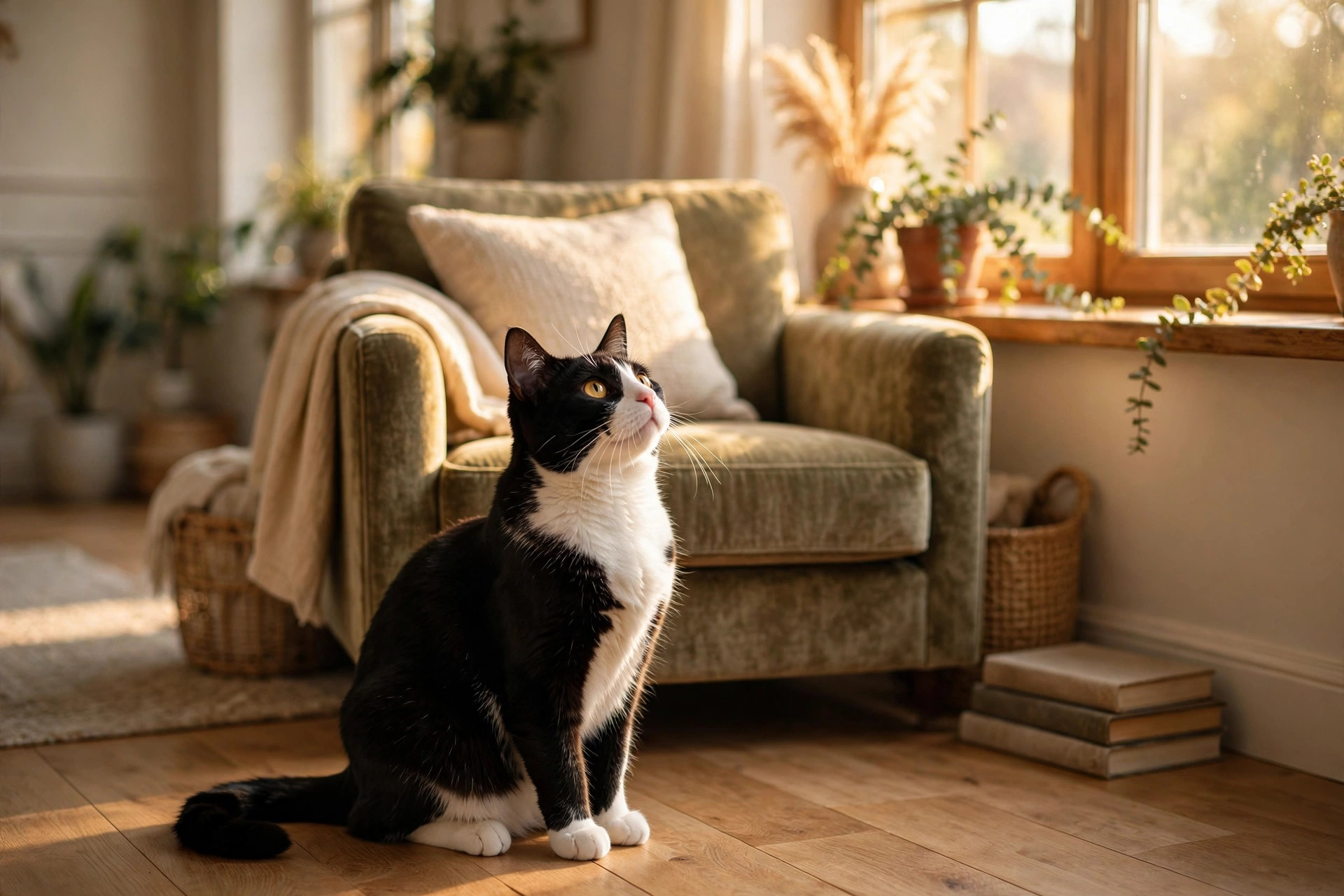
Biscuit has a windowsill. It is the good windowsill — wide, sun-struck from noon until four, overlooking the street where the important neighbourhood business happens. For years he reached it the same way: one gathered, contemptuous leap, straight from the floor, the way a king takes a throne that was built for him.
This autumn I noticed something. He still goes to the windowsill. But now he goes via the armchair. A small pause. A measuring look. Then the two-stage route — floor to chair, chair to sill — where the single leap used to be.
He did not limp. He did not cry out. He did not ask for help, because cats do not ask for help; they simply edit their lives around the pain and hope you are paying attention.
Tomorrow, 12 October, is World Arthritis Day. And the numbers on feline arthritis should make every cat owner sit very still: in one landmark study, radiographs showed degenerative joint disease in 90% of geriatric cats — yet only 4% of those cats had any mention of arthritis in their veterinary records. Nine in ten had it on the X-ray. Almost nobody knew.
That gap — between what the joints show and what the household notices — is the most important health story in the cat world. And it is the one we are going to close today, before Biscuit's armchair route becomes the only route.
Why nobody noticed
The 90-and-4 figure comes from Hardie and colleagues, published in 2002, and it has been confirmed in spirit by study after study since: degenerative joint disease in cats is extraordinarily common and extraordinarily under-recognised. A Japanese radiographic survey of 101 cats found evidence of appendicular osteoarthritis in three out of four animals, with the elbow the most commonly affected joint and the vast majority of cases striking both sides of the body at once.
And here is the cruelty of it: cats are evolutionary masters at hiding pain. A limping animal in the wild is a marked animal, so cats learned, over millions of years, to absorb discomfort and carry on. Your cat is not stoic out of nobility. She is stoic out of ancient software.
So the signs do not look like pain. They look like age. They look like personality. The cat that "slows down" at twelve is filed under getting old — and the file is closed. But slowing down is not a diagnosis. It is a symptom with its name rubbed off.
The seven quiet signs
Watch for changes, not moments. Arthritis in cats announces itself in the negative space — the things that stop happening.
1. The edited jump. This is the classic. The leap that gets shorter, the pause before the spring, the new habit of taking the stairs of furniture — chair, then shelf, then sill — where one bound used to do. If your cat has started planning jumps, the joints are doing the talking.
2. The hesitation. A cat that used to pour itself over the sofa arm now stops, considers, and sometimes declines. Hesitation before jumping up or down is one of the most reliable behavioural flags vets ask about.
3. The changed sleeping geography. Cats in joint pain gravitate to lower, warmer, easier-to-reach spots. The top of the wardrobe goes unvisited. The heated patch by the radiator becomes the entire world. Ask yourself: when did she last sleep somewhere high?
4. The grooming gaps. A stiff cat cannot twist to groom the way she used to. The result is a duller coat, sometimes matted fur along the back and hindquarters — the places that require the most spinal flexibility. Owners often read this as laziness. It is logistics.
5. The litter-box rethink. Stepping over a high litter-box wall hurts arthritic hips and elbows. Misses, perching on the edge, or a sudden preference for going just outside the box are frequently a protest against the architecture, not the animal.
6. The shorter fuse. Pain makes anyone irritable. A cat that flinches, moves away, or growls when stroked along the back or lifted under the chest may be guarding sore joints — not developing a bad temper.
7. The quieter days. Less play. Longer naps. A general dimming of the mischief. Each change is easy to explain away on its own; together, over weeks, they are a pattern. Patterns are what diagnoses are made of.
If you recognise three or more of these, this is not an article to bookmark. It is a vet appointment to make.
What the vet can actually do — and it is more than it used to be
Here is the genuinely good news, and it is recent. For decades, feline arthritis was a condition vets could see on an X-ray but barely treat: cats tolerate very few painkillers safely, and pilling a cat daily is a negotiation nobody wins.
That changed. Solensia — the brand name for frunevetmab — was approved in the EU in February 2021 and by the US FDA in January 2022, and it was the first monoclonal antibody drug ever approved for use in any animal species. It is a cat-specific antibody that attaches to nerve growth factor, the protein that carries the pain signal from an arthritic joint toward the brain — and blocks it from arriving.
It is given as a single injection under the skin, once a month, at the vet clinic. No daily pills. No wrestling. Most cats begin moving more freely within a few weeks. It is prescription-only, which means the first step is still the same: a vet who examines the cat, confirms the diagnosis (usually with X-rays), and decides whether the treatment fits.
This is why the quiet signs matter so much. The treatment exists now. The bottleneck is no longer medicine — it is noticing.
The royal home protocol: six decrees
While the vet handles the medicine, the household handles the terrain. Small changes, large mercy:
1. Lower the walls. Switch to a litter box with a low entry side — or cut one side down. The box should be a stroll, not a hurdle.
2. Build the staircase. Place a sturdy step, ottoman, or pet stairs beside every favourite high spot: the windowsill, the bed, the good armchair. Biscuit's armchair route was his own engineering. Make it official.
3. Warm the throne. Stiff joints hate the cold. A padded bed in a warm, draught-free spot — ideally where the sun lands — is not pampering. It is physiotherapy with better lighting.
4. Mind the weight. Every extra ounce loads the joints further, and an overweight cat with arthritis is fighting on two fronts. Keep meals measured and play gentle but regular — short, low-impact sessions beat heroic ones.
5. Traction, please. Slippery floors turn every crossing into a risk assessment. A rug runner along the cat's main routes gives arthritic paws the grip that confidence is made of.
6. Raise the banquet. Food and water at a comfortable height — slightly elevated bowls — spare the neck and shoulders the long downward stretch, twice a day, every day, for years.
The one hard rule
Never, ever give a cat human painkillers. Ibuprofen, paracetamol (acetaminophen), aspirin — the medicines in your own cabinet can be toxic or fatal to cats, whose livers process these drugs entirely differently from ours. This is not a "check with your vet first" situation. It is a "never" situation. If your cat is in pain, the vet has safe options. Your medicine cabinet does not.
The Tyrant's Verdict
Biscuit still takes the windowsill via the armchair. He has also acquired, as of this week, a small upholstered step beside it — placed with ceremony, inspected with suspicion, and then adopted within the hour as though it had always been there and he had merely been too polite to ask.
He is not old. He is not "slowing down." He is a cat whose joints are changing, the way joints do, and whose staff has finally learned to read the edits.
Tomorrow is World Arthritis Day. Look at your cat tonight — really look — and ask the question the X-rays have been answering for twenty years: what has she stopped doing lately? The answer might be nothing. But if it is something, you now know what to do with it: the vet, the stairs, the warm bed, and never the medicine cabinet.
Somewhere in a radiology archive, nine out of ten senior cats are carrying joint changes nobody recorded. Your cat does not have to be the tenth file that stays closed.
The articles of this desk are written to inform, never to diagnose. If you recognise these signs, your veterinarian is the next chapter — not this one.
The royal decree, in short
- Radiographs showed degenerative joint disease in 90% of geriatric cats (Hardie et al., 2002) — but only 4% had it in their records. The most under-noticed disease in the cat world.
- Cats hide pain by ancient design; the signs look like age, not illness — edited jumps, hesitations, a changed sleeping geography.
- The seven quiet signs: shorter jumps, hesitation, lower sleeping spots, grooming gaps, litter-box architecture protests, a shorter fuse, quieter days. Three or more means a vet appointment, not a bookmark.
- Solensia (frunevetmab): EU February 2021, US FDA January 2022 — the first monoclonal antibody approved for any animal — a monthly injection at the clinic that blocks nerve growth factor and the pain signal.
- The royal home protocol: low-entry litter box, steps to favourite perches, a warm padded bed, healthy weight, traction rugs, slightly raised bowls.
- Never give human painkillers — ibuprofen, paracetamol and aspirin can be toxic or fatal to cats. Pain belongs to the vet, not the medicine cabinet.
Sources & further reading
- ResearchGate — Hardie et al. (2002), "Radiographic evidence of degenerative joint disease in geriatric cats": researchgate.net
- Frontiers in Veterinary Science — Kimura et al. (2020), retrospective radiographic study of DJD in 101 cats: frontiersin.org
- PMC — "Osteoarthritis in cats: what we know, and mostly, what we don't know… yet": pmc.ncbi.nlm.nih.gov
- Nasdaq (RTTNews) — "FDA Approves First Treatment To Control Pain In Cats With Osteoarthritis": nasdaq.com
- WebMD — "Frunevetmab (Solensia) for Cats": webmd.com
- The Movie Boards — "Pay Attention to Your Cats" (World Arthritis Day, 12 October): themovieboards.net