The Slow Blink: The Science Behind Your Cat's "I Love You"
Scientists at Sussex and Portsmouth proved the slow blink is real communication — two experiments, one shelter study, and how to blink back like royalty.
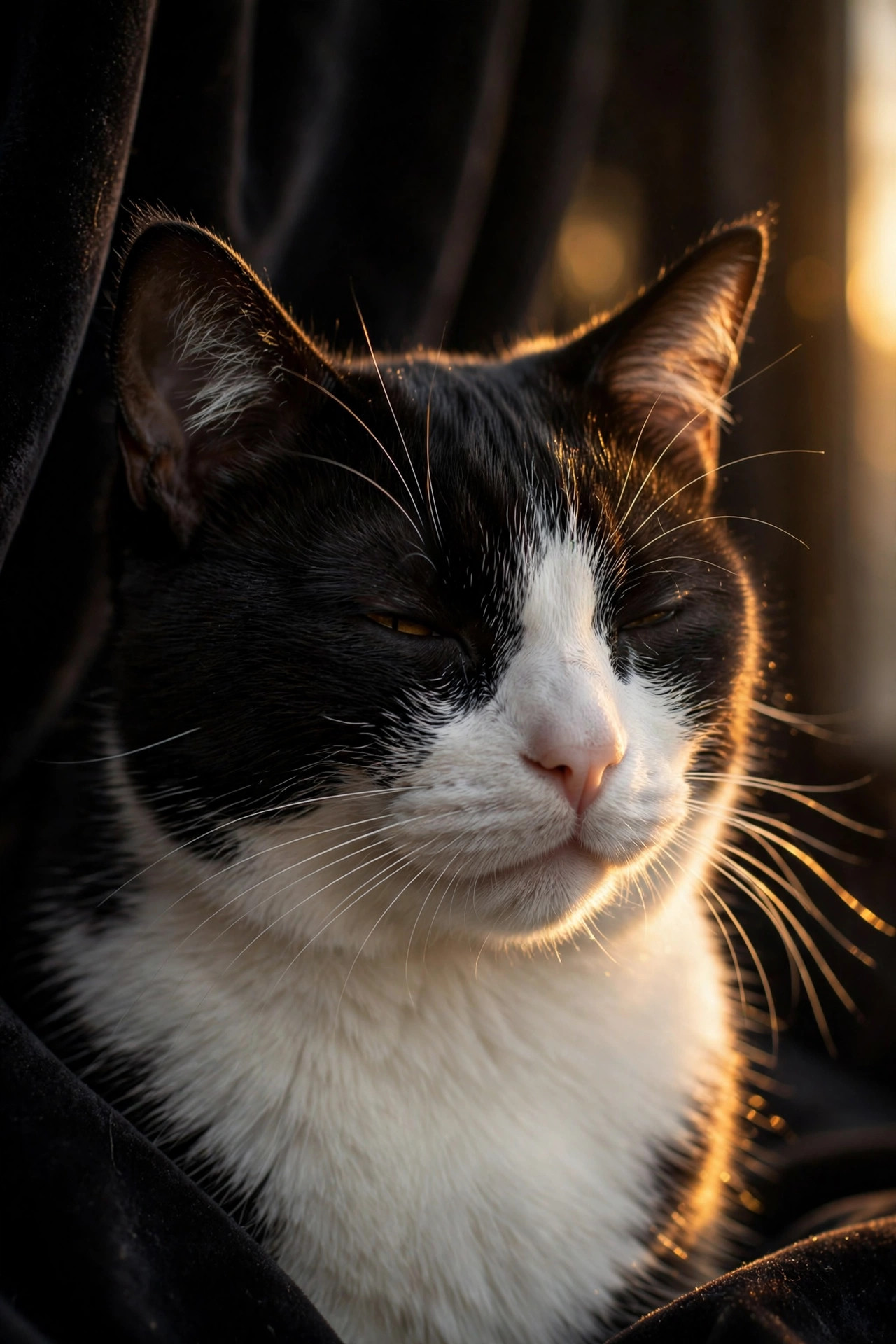
Biscuit does it from the good armchair, usually in the late afternoon, usually when I have stopped being interesting and started being furniture. The eyes go to half-mast. The lids drift down, hold, release — slowly, deliberately, the way royalty signs a document. Then he keeps looking at me, softer than before.
For years, cat owners have read this look the same way: affection. Trust. The feline "I love you." And for years, that was folklore — charming, unscientific, unprovable. Then, in October 2020, two universities ran the experiments, and it turned out the folklore was, roughly, right.
Here is what the slow blink actually is, what the science genuinely proved, and how to answer it in the one language your cat is fluent in.
The look has a technical definition
What we call a slow blink, researchers describe as a sequence: successive half-blinks followed by either a prolonged narrowing of the eyes or a full eye closure. It is not a sleepy droop and it is not a squint. It is rhythmic, unhurried, and — this matters — it happens while the cat is otherwise alert and looking at you.
It has a popular nickname too: the "cat smile." The nickname is older than the science, and it turned out to be more accurate than anyone had a right to expect.
Owners knew first; science arrived in 2020
Before the studies, the slow blink belonged to the oral tradition of cat ownership — the same tradition that produced "the purr means happiness" and "the box is always the right size." Some of that tradition is nonsense. This particular piece of it, a team of animal behaviour scientists decided to test.
The team was led by Dr Tasmin Humphrey and Professor Karen McComb at the University of Sussex, with Dr Leanne Proops of the University of Portsmouth, and their paper — "The role of cat eye narrowing movements in cat–human communication" — was published in the Nature journal Scientific Reports. It was, by the authors' own account, the first experimental investigation of the role of slow blinking in cat–human communication. Nobody had actually run the control conditions before.
So they did, twice.
The experiment that proved it
Experiment one took place in the cats' own homes: 21 cats across 14 households. Owners were instructed to slow-blink at their cats — narrow the eyes, close them briefly — and the researchers measured the response. Cats were significantly more likely to slow-blink back at their owners after the slow-blink stimulus than when the owner was simply present and doing nothing. The look is contagious, in the specific way that social signals are.
Experiment two raised the stakes. This time the blinker was not the owner but a researcher the cat had never met — 24 cats across 8 households. After the slow-blink stimulus, the cats were not only more likely to blink back; they were more likely to approach the experimenter's outstretched hand than when the same stranger wore a neutral expression. Think about that: a stranger, one facial expression, and the cat chose to walk closer.
The researchers drew a parallel that should delight anyone who has ever been slow-blinked at: cat eye-narrowing has something in common with the genuine human smile — the Duchenne smile, the one that reaches the eyes. Eye-narrowing in positive situations shows up in other species too. The slow blink, in other words, belongs to a family of expressions that mean, across species, I am at ease with you.
Why would a predator smile at you?
Here the science gets honest about what it does not know, and the honesty is worth hearing.
The researchers offered three possible explanations for why cats developed the slow blink at all. One: cats developed the behaviour because humans perceived slow blinking as positive — we rewarded it, so it flourished. Two: cats simply learned that humans respond warmly when they blink slowly, and kept doing the thing that worked. Three, and most interesting: the slow blink may have begun as a way to interrupt an unbroken stare — and in the social world of cats, a fixed, unblinking stare is a potential threat. Breaking it is diplomacy.
All three may be true at once. None of them diminishes the gesture. A signal that evolved to disarm both species is arguably more impressive than one that was always sentimental.
The shelter proof
The follow-up study is the one that settles it. The same team — Humphrey, Stringer, Proops and McComb — took the question into a cat shelter: 18 cats, real stakes, published in the journal Animals. They asked two things: does a cat's response to human slow-blinking predict how fast it gets adopted, and is slow-blinking related to anxiety around humans?
The answer to the first was yes, strikingly so. Cats that produced more — and longer — eye closures in response to a human's slow blink were rehomed faster than cats that closed their eyes less. A slow blink, delivered at the right moment, measurably improved a shelter cat's odds of going home.
The answer to the second was subtler and more moving. The nervous cats — the ones already identified as needing desensitisation to humans — tended to spend more time producing slow-blink sequences in response to human slow blinks than the confident ones. The researchers concluded the slow blink may have a dual function: affiliative in the relaxed cat, appeasing in the frightened one. It is not only "I love you." Sometimes it is "please don't be scary." Either way, it is a cat choosing communication over withdrawal — and that deserves an answer.
How to slow-blink back, the royal way
Professor McComb's own instructions are disarmingly simple, and they work on the neighbour's cat as well as your own:
1. Soften first. Narrow your eyes the way you would in a relaxed, genuine smile — not a squint, not a leer. The expression starts in the muscles around the eyes, not in the lids.
2. Close, hold, release. Close your eyes for a couple of seconds, then open them slowly. One deliberate cycle beats five nervous flutters.
3. Never open with a stare. If you have been fixedly gazing at your cat — and be honest, you have — the slow blink is how you apologise for it. A long unbroken stare reads as a challenge; the blink is the white flag that precedes the treaty.
4. Let the cat set the tempo. Slow-blink once, then wait. If the cat blinks back, you have started a conversation. If it looks away, you have been politely declined, and a gentleman accepts the verdict.
5. Deploy it strategically. New cat in the house? Cat hiding under the bed at the vet? Shelter cat you are considering? The slow blink is the single highest-leverage social tool you own, and it costs nothing.
Biscuit, it should be noted, slow-blinks at delivery drivers through the window. He considers this diplomacy. The drivers consider it adorable. Both parties are correct.
One honest caution
Royalty deals in truth, so here it is: the science proves the slow blink is positive communication. It does not prove it is a literal translation of "I love you," and anyone selling you that translation is selling you something. What the experiments show is rapport, approachability, ease — the preconditions of affection, not the word itself. That is plenty.
And one medical footnote, because the doctrine of this desk is zero misdirection: a slow blink is rhythmic and relaxed. A squint — eyes held narrow or shut, especially with pawing, tearing, discharge, or a sudden change — is a different thing entirely and can signal eye pain. Squinting is a vet visit. Slow-blinking is a love letter. Learn to tell them apart.
The Tyrant's Verdict
Biscuit has never read the Sussex paper. He does not know that 21 cats in 14 households blinked back, or that 18 shelter cats blinked their way home faster. He knows only that when he goes to half-mast from the good armchair, the staff goes soft, the stroking improves, and occasionally a treat materialises as if by diplomacy.
Yesterday I slow-blinked at him first — narrowed eyes, two-second close, slow release, exactly per protocol. He held my gaze for a beat. Then the lids drifted down, held, and released, and he went back to supervising the room.
Somewhere in Sussex, a researcher would call that a successful trial of interspecific positive communication. Here, we just call it Tuesday.
The royal decree, in short
- The slow blink is a defined sequence — successive half-blinks followed by prolonged eye narrowing or closure — and researchers call it the "cat smile."
- The landmark 2020 study (Humphrey, McComb, Proops — Universities of Sussex & Portsmouth, Scientific Reports) ran two experiments: 21 cats blinked back at slow-blinking owners, and 24 cats were more likely to approach a stranger's outstretched hand after a slow blink.
- Cat eye-narrowing parallels the genuine human Duchenne smile — both signal ease across species.
- The shelter follow-up (18 cats, Animals): cats that responded to human slow blinks with more, longer eye closures were rehomed faster; nervous cats blinked more — so the slow blink can mean "I trust you" or "please don't be scary."
- Blink back like royalty: soften the eyes as in a relaxed smile, close for a couple of seconds, open slowly — never open with a stare, and let the cat set the tempo.
- A rhythmic slow blink is affection; a held squint with pawing, tearing, or discharge is a vet visit — learn to tell them apart.
Sources & further reading
- Neuroscience News — "Psychologists Reveal How to Build Rap-Paw With Your Cat" (University of Sussex release): neurosciencenews.com
- BBC Science Focus — "Want to make friends with a cat? Blink slowly, say scientists": sciencefocus.com
- MDPI Animals — Humphrey et al., "Slow Blink Eye Closure in Shelter Cats Is Related to Quicker Adoption" (2020): mdpi.com
- The Jerusalem Post — experiment detail (21 cats across 14 households; 24 across 8): jpost.com