The Sudden Nip: Decoding Your Cat's "Love Bites"
Why does a happy cat suddenly bite mid-petting? A vet behaviorist's verdict on "love bites," the four warning signs you keep missing, and how to respond like staff instead of prey.
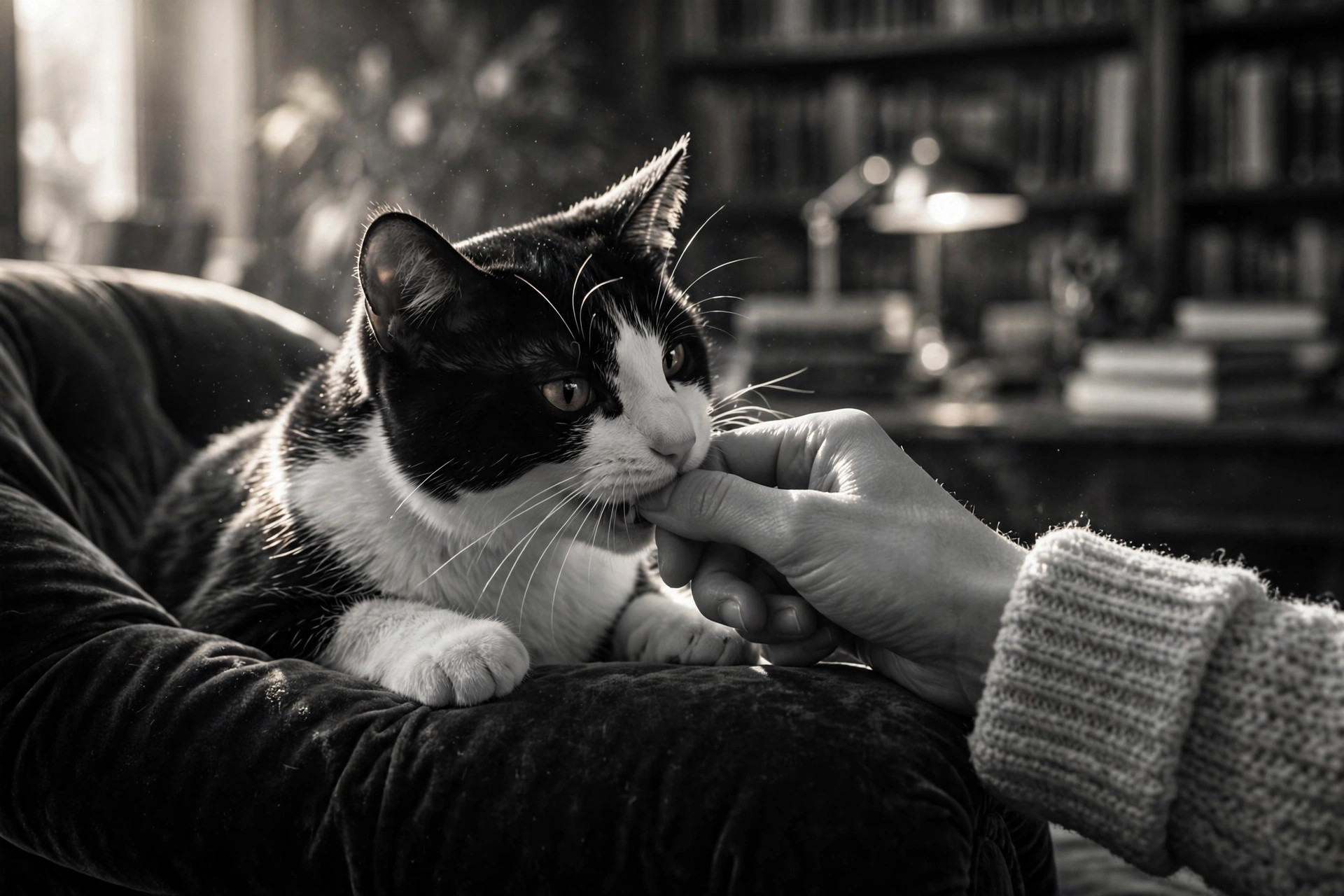
Biscuit was purring. This is not an exaggeration or a guess; the purr was a full, engine-room rumble, the kind that vibrates through the armrest and into your elbow. He was draped across the arm of the good armchair, eyes half-shut, being stroked exactly the way he likes it — behind the ears, down the spine, a rhythm we had clearly negotiated over months. And then, without any change in the weather, he folded his teeth around my hand and applied a precise, personal, unmistakable pinch.
Not a mauling. Not a warning snarl. A memo, signed with teeth.
If you share your house with a cat, you have received this memo. The hand was welcome; then, in the same afternoon, the hand became too much. The internet has named it the "love bite." Veterinary behaviorists have a blunter name: petting-induced aggression. And decoding it properly will change the way you touch your cat forever — which is exactly the kind of thing a well-run household should want.
The bite has an official title
Feline experts are not fond of the term "love bite," because the term flatters us while obscuring what is actually happening. The clinical name — petting-induced aggression — describes a specific, well-documented pattern: a cat that was genuinely enjoying the petting becomes overstimulated, crosses an invisible threshold, and uses its teeth to end the interaction.
Dr. Kelly Ballantyne, a board-certified veterinary behaviorist at the University of Illinois, put it plainly: "When cats bite in this context, it's not a sign of affection, but rather a signal that the cat is done with the interaction. If the petting continues despite the cat's efforts to signal that he or she is done with being petted, the cat may escalate to a [real] bite."
Read that twice, because it overturns the most common misunderstanding in the household. The bite is not the beginning of the conversation. It is the end of one you failed to notice. Biscuit had been talking for a while; I was simply too busy enjoying the purr to read the minutes.
Three meanings of the nip
The sudden nip is not one behaviour but three, and learning to tell them apart is the difference between staff and subject.
One: "Enough." This is the classic petting-induced nip. Cats have sensitive nerve endings across their bodies — particularly along the back, tail, and belly — and their tolerance for continuous contact is genuinely finite. The maddening part is that nothing about the petting has to change. Same hand, same rhythm, same happy cat; then the threshold is crossed and the experience flips from pleasure to static. This is why owners describe the bite as coming "out of nowhere." It did not. The threshold was there all along; the cat was simply too content to file the paperwork until it wasn't.
Two: "You are one of us." Watch how cats groom each other and you will see licking punctuated by small, precise nips — it is the rhythm of allogrooming, the social grooming that functions as feline social glue. When your cat licks your hand and follows with a gentle bite, it may be grooming you the way it would groom a member of its own family group. These nips are usually soft, often start from licking, and carry no tension in the body. This is the one version of the memo that really is affectionate: you have been adopted into the fur.
Three: "Let's fight, but politely." Young cats, and some perennial kittens like Biscuit on his better days, nip during play — the hunting practice hardwired into every paw. The hand that wiggles becomes, in the feline mind, something that wiggles like prey. This is why behaviourists plead with owners to use toys rather than hands during play: a hand that plays becomes a hand that may be hunted.
The court publishes its edicts; the staff ignores them
Here is the humbling part. The cat almost always warns you. The SF SPCA's behaviour handout lists the signals owners must learn to read: restlessness, the tail beginning to twitch, the ears turning back or flicking, the cat turning its head toward your hand. Others add skin rippling along the back, a subtle stiffening of the body, dilated pupils.
These are not mysterious omens. They are ordinary body language, broadcast at full volume — and missed because humans are busy being charmed. Biscuit's tail goes to work like a metronome for a full half-minute before the nip. The evidence was not absent; the jury was asleep.
Learn the sequence the way you would learn the moods of any small monarch: tail flick, ear shift, skin ripple, head turn. When any of them appears, the audience is over — and you, the audience, should leave before you are asked.
How to answer the memo
The correct response to the sudden nip is to stop. Not theatrically, not with a yelp that startles the cat, and certainly not with punishment — the behaviour handout is explicit that any physical punishment almost always makes the problem worse, because fear makes future petting even more unpleasant to anticipate. Simply withdraw the hand, give the cat space, and let the interaction end the way the cat asked for it to end.
Then, longer term, renegotiate the treaty. Keep petting sessions shorter than you think you need — many cats are happiest with brief, intense bursts rather than long marathons. Pet where the cat actually likes it (behind the ears, under the chin, along the cheeks) and respect the no-fly zones (most cats dislike the belly and resent long strokes down the tail). If you want to extend the session, offer a tiny food reward as the tolerance signs begin, and ease off the intensity — over time, petting becomes associated with good things instead of the prelude to an eviction. And if playfulness is the driver, retire the hand as a toy and bring in a wand.
Biscuit's treaty, for the record: chin and ears, three minutes maximum, and the session ends the moment the tail writes its first sentence. He has not nipped me since. The court appreciates a staff that can read.
When the nip is news
One honest exception, because the doctrine of this desk is zero misdirection: if a cat that has never bitten starts biting, or a gentle nipper suddenly bites harder and more often, the cause may not be in the petting at all. Pain — dental trouble, arthritis, an injury you cannot see — can make ordinary touch feel like an attack. A sudden change in biting behaviour is a veterinary question, not a training one. The nip, in that case, is not a memo but an alarm.
The Tyrant's Verdict
Biscuit bit my hand on a Tuesday, gently, and has not needed to do it again — because the staff, eventually, learned to read. That is the whole story of the sudden nip: a creature of precise, ancient manners dealing with a species that is chronically slow on the uptake. The bite was never about cruelty, or ingratitude, or love, exactly. It was about a threshold, a warning system, and a reader who finally showed up.
The purr is a cat's music. The nip is its punctuation. Learn the grammar, and you will stop being surprised by the sentences.
The royal decree, in short
- Vets call it petting-induced aggression, not "love bites" — per board-certified veterinary behaviorist Dr. Kelly Ballantyne (University of Illinois): the bite signals the cat is done with the interaction, and continuing risks escalation to a real bite.
- The nip has three meanings: "Enough" (overstimulation threshold crossed), "You are one of us" (allogrooming — social grooming borrowed from cat-to-cat bonding), and play (your hand became prey).
- Four warning signs always precede it: tail flicking, ears shifting back, skin rippling along the back, and the head turning toward your hand.
- Answer the memo by stopping — no punishment (it makes future petting worse), shorter sessions, petting the liked zones (ears, chin, cheeks), and using toys instead of hands for play.
- A sudden increase in biting in a previously gentle cat can mean pain (dental, arthritis, injury) — that is a vet visit, not a training problem.
Sources & further reading
- Cattitude Daily / PetMD — Dr. Kelly Ballantyne on "love bites" vs. petting-induced aggression: cattitudedaily.com
- SF SPCA — "Understanding Cat Aggression Towards People" (behaviour handout): sfadopt.com
- HowStuffWorks — "Why Does My Cat Lick Me, Then Bite Me?" (allogrooming): animals.howstuffworks.com
- Business Upturn — "Why Cats Suddenly Bite While Being Petted" (overstimulation thresholds): businessupturn.com
Keep reading the Desk
The Slow Blink: The Science Behind Your Cat's "I Love You"
Scientists at Sussex and Portsmouth proved the slow blink is real communication — two experiments, one shelter study, and how to blink back like royalty.
Read the story →
The 3 a.m. Grand Prix: The Real Science of the Zoomies
Your cat turns into a hallway rocket at 3 a.m. every night. The science behind the zoomies — four theories, one real term (FRAPs), and the night-peace protocol that actually works.
Read the story →
The Bowl Under the Microscope: What the Heavy Metals Headlines Really Mean for Your Cat
The 99%-of-cat-foods headline, decoded: what the new heavy-metals report found, what it didn't prove, and five calm royal decrees for a safer bowl.
Read the story →