The 3 a.m. Grand Prix: The Real Science of the Zoomies
Your cat turns into a hallway rocket at 3 a.m. every night. The science behind the zoomies — four theories, one real term (FRAPs), and the night-peace protocol that actually works.
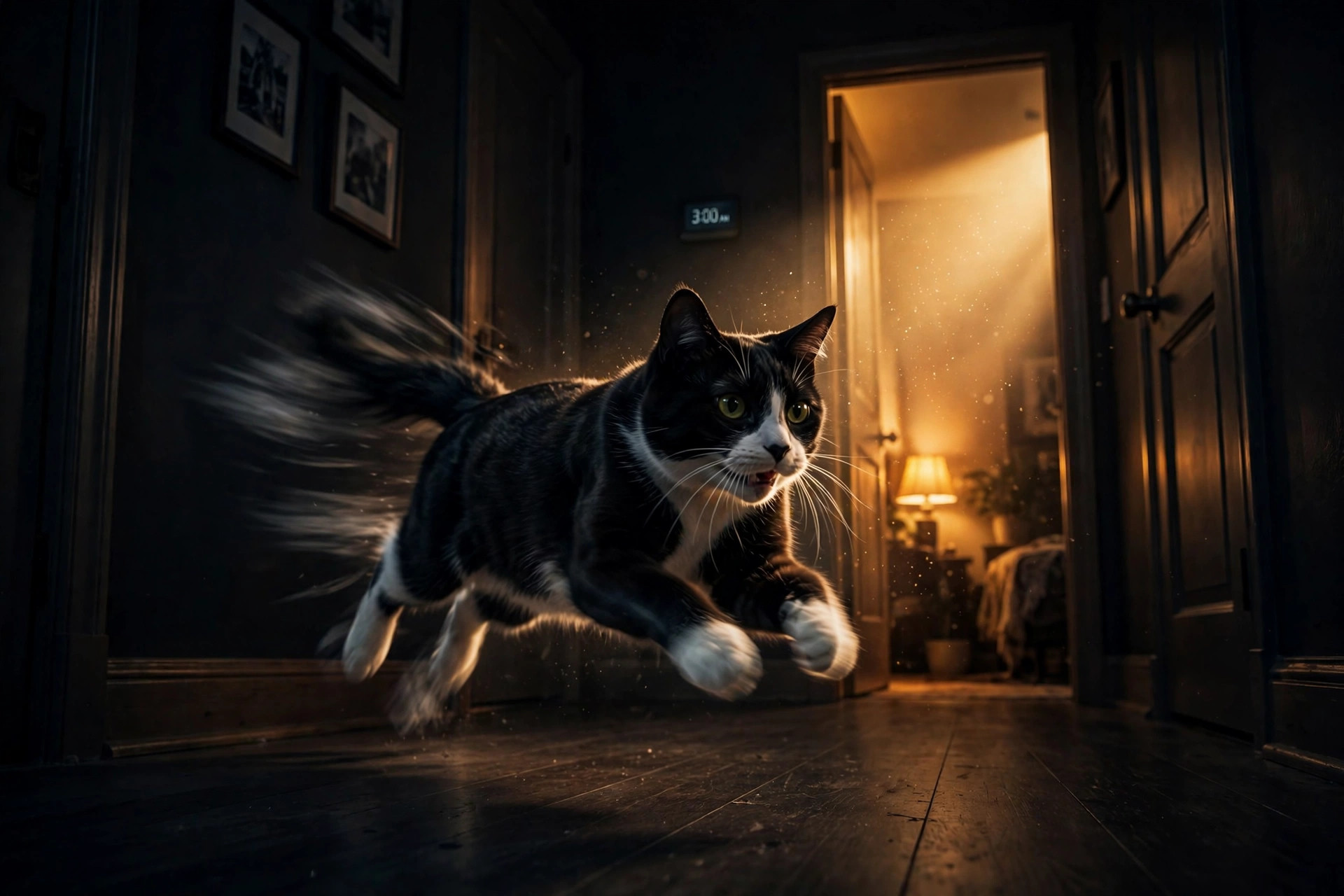
At precisely 3 a.m. last Tuesday, my hallway became a racetrack — four paws thundering off the walls, the sofa used as a launchpad, a hallway table rattled to within an inch of its life. Then silence, and Biscuit, breathing slightly hard, looking like a champion catching his breath.
At 3 a.m. nobody is angry; one is simply awake, wondering what ancient force has seized the little dictator of one's house.
Here is the answer: the behavior has a real technical name, the theories are better than most people know, and you can genuinely do something about it.
The zoomies have a real scientific name
Veterinarians and animal behaviorists call these episodes Frenetic Random Activity Periods — FRAPs. The name is honest: frenetic, seemingly random, and always a period — thirty seconds to a few minutes of pandemonium, after which the cat returns to its regularly scheduled napping as though nothing happened.
The word "zoomies" has described pet behavior since at least the early 2000s — and the pattern shows up across species: dogs do it, rabbits do it. This is not a glitch. It is a designed feature.
Theory one: the crepuscular clock
Your cat is not nocturnal. This is one of the most common myths in cat ownership, and it costs people a great deal of sleep.
Cats are crepuscular — most active at dawn and dusk. Bruce Kornreich, a veterinary cardiologist and director of the Cornell Feline Health Center, has explained it plainly: this is when a cat's prey is most active, so the whole predator system is wired to switch on in the twilight hours. Your cat has never seen a mouse; the clock still ticks in its bones.
Meanwhile the healthy adult housecat sleeps between 12 and 16 hours a day — in short, light, polyphasic bouts, not one long stretch. That leaves two concentrated windows of high energy, and one of them lands squarely in the middle of your sleep.
So the 3 a.m. Grand Prix is not sabotage. It is a crepuscular animal having its crepuscular moment at precisely the wrong time for you. The cat's internal calendar says hunt; your alarm says three hours from now.
Theory two: the pent-up predator
A domestic cat is an ambush hunter that was never redesigned for apartment life: stalk, wait, explode into a sprint, stop. Evolution never issued a software update announcing that food now arrives in a bowl.
All that unspent hunting hardware has to go somewhere. When a cat has slept through the day — and your indoor cat has had nothing to do all day but wait for you — the energy accumulates. Then it discharges all at once: the sprint, the hairpin turns, the pounce at nothing. That is not your cat being weird. That is your cat being, for two minutes, the athlete it was built to be.
Zoomies hit kittens and young cats hardest: high metabolism, high energy, zero furniture etiquette.
Theory three: the high-arousal trigger
Some zoomies arrive right after a high-arousal moment — after a bath, a sudden noise, a rowdy play session. The behavior then works as a tension-release mechanism: the cat is not just running, it is resetting — the feline equivalent of shaking out your hands after a tense meeting, only louder and harder on your hallway table.
Theory four: poo-phoria
Yes, really. Many owners report that the zoomies strike right after a trip to the litter box, and scientists have a theory for this one too.
The term is "poo-phoria" — coined by gastroenterologist and author Dr Anish Sheth. His theory, reported by BBC Science Focus: passing a large stool stimulates the vagus nerve, the long nerve linking the brain to the organs of the abdomen. That stimulation can drop heart rate and blood pressure and trigger a moment of light-headedness — which in a cat expresses itself as a sprint away from the litter box.
Competing theories exist — the clean-animal instinct, the wild-predator logic, simple relief. None are proven, but the vagus-nerve theory has the most physiology behind it, and one undeniable advantage: it makes the funniest behavior in the house sound like neuroscience.
When the zoomies are a warning
Zoomies are almost always healthy. But changes in the pattern can mean something — and cats are famously good at hiding pain.
Take the cat to a veterinarian if the zoomies change character — more frantic, more frequent, paired with anything unusual:
- Pain can look like zoomies. Cats disguise pain, and frantic bursts are one way they cope. Sprints plus excessive scratching, licking, or discomfort are a vet visit, not a funny video.
- Unusually frantic restlessness can signal hyperthyroidism, among other conditions. Age plus a suddenly wired personality deserves a blood panel.
- Post-poop zoomies plus digestive trouble — straining, crying, a painful-looking visit — can signal a gastrointestinal problem, not just euphoria.
- And the mundane one: a dirty litter box explains a fast exit every time. Check the box before theorizing about the vagus nerve.
Zoomies in a healthy, eating, drinking, box-using cat are joy. In a cat that is otherwise off, they are information.
The Royal Night-Peace Protocol
Now the part worth the price of admission. Cat behaviorist Jackson Galaxy's framework has fixed more 3 a.m. hell-raisers than any other advice in the business, and it rests on one insight: the zoomies are not the problem — the missing routine is.
His mantra: hunt, catch, kill, eat, groom, sleep. That is the wild cat's sequence, and when you build your cat's evening around it, the body learns that the day is winding down. Here is how to run it:
1. Two real play sessions a day, ten minutes each. Morning and evening, with hunting-style toys — wand toys and feather toys moved like prey. Play until the cat is genuinely tired. This is the single highest-leverage thing you can do.
2. Play before the evening meal, not after. Play, then serve dinner — the body reads it as a completed hunt, which triggers grooming, then sleep.
3. Schedule the meals; end the grazing. Predictable mealtimes regulate energy rhythms the way an all-day bowl never does. Galaxy's advice for the 3 a.m. wake-up call: time the last meal roughly 90 minutes before bed, with a real play session right before it.
4. When the wake-up call comes anyway, play dead. No feeding, no talking, no eye contact. Any response — positive or negative — teaches the cat that the 3 a.m. routine works. Give the protocol a week to ten days.
5. Audit the arena. A hallway the cat sprints at night should not contain the vase your grandmother gave you. Zoomies are safe when the track is clear.
Notice what this protocol is not: scolding, spray bottles, or locking the cat away. You cannot argue a predator out of its crepuscular hour. You can only redirect the energy to a better hour — and take the credit when it works.
The Tyrant's Verdict
Biscuit is on the protocol now. Evenings: ten minutes of wand-toy combat, dinner, a dignified grooming session, and then sleep. The 3 a.m. Grand Prix has been downgraded to the occasional 6 a.m. parade lap, which is within acceptable treaty terms.
Last week I woke at half past three to the sound of thunder and thought the war had resumed. It was Biscuit, sitting at the end of the hallway, staring at me in the dark. He had simply come to check that the track was still his.
It is. But the race now starts at six — and that, for a household ruled by a tuxedo cat, counts as diplomacy.
The royal decree, in short
- The zoomies are FRAPs — Frenetic Random Activity Periods, a healthy, cross-species burst of pent-up energy (slang in use since at least the early 2000s).
- Cats are crepuscular (dawn/dusk peak), not nocturnal; healthy adults sleep 12–16 hours a day in short bouts — so one energy window lands in your sleep.
- Four theories: the crepuscular clock, the pent-up predator, high-arousal tension release, and poo-phoria — vagus-nerve stimulation after defecation, named by Dr Anish Sheth.
- See a vet if zoomies change character — possible pain, hyperthyroidism, or digestive trouble; and always check the litter box first.
- The night-peace protocol: two 10-minute play sessions daily, play before the evening meal, scheduled meals (last one ~90 min before bed), and play dead when the 3 a.m. wake-up call comes — a week to ten days of this resets the clock.
- This is educational, not veterinary advice — when in doubt, ask your own vet.
Sources & further reading
- Dictionary.com — "zoomies" slang entry (April 25, 2022): dictionary.com
- Inverse — "Why Is My Cat Awake At Night?" with Cornell Feline Health Center's Bruce Kornreich: inverse.com
- BBC Science Focus — "The (very adorable) reasons cats get the zoomies after pooping": sciencefocus.com
- Phys.org — "Why do cats and dogs get 'the zoomies'?": phys.org
- Ultimates Indulge — Jackson Galaxy's routine/ritual/rhythm and the play-before-meals rule: ultimatesindulge.com.au
- Jackson Galaxy on TikTok — the 3 a.m. wake-up protocol (scheduled meals, play session before the last meal, play dead): tiktok.com
- Summer's Fabulous Cat Life — "Zoomies: Why We Cats Do That" (10-minute play sessions): sparklecat.com
- Armarkat — "Do You Know Zoomies?" (when frantic bursts can mean pain): armarkat.com