The Cat on the Doorstep: What to Do When a Stray Chooses You
National Feral Cat Day is this Friday, 16 October. A lean cat has started appearing at your gate — how to read it, feed it, vet it, and decide what comes next, with the science of TNR and the kitten socialisation clock.
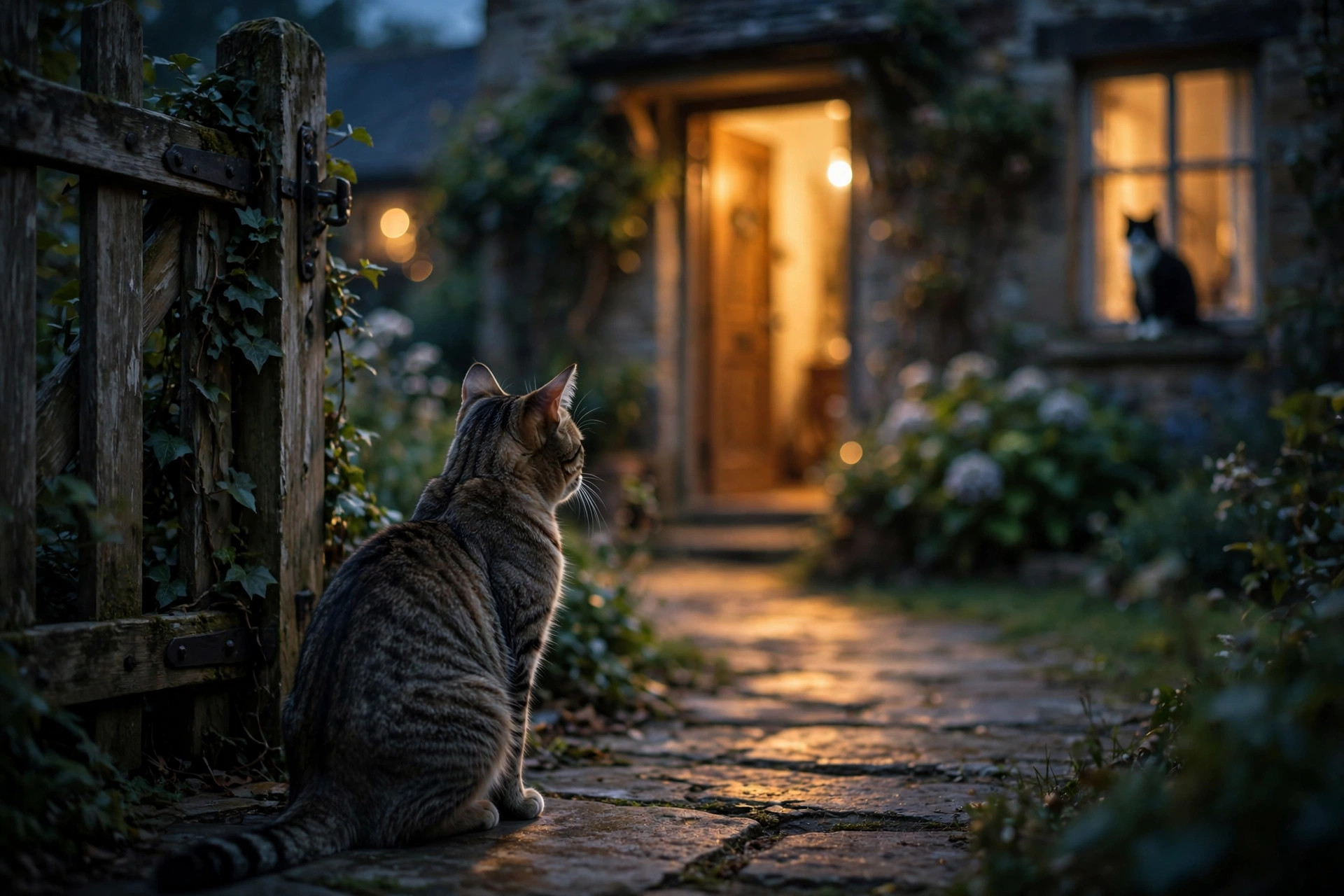
It started three evenings ago, at dusk. A lean tabby at the garden gate — ribs faintly visible under a coat gone rough at the edges, one ear with a small notch that might have been a fight or might have been nothing. He did not come closer. He sat exactly at the boundary where the street becomes ours, and waited to see what kind of people we are.
Biscuit watched the whole scene from the windowsill with the particular stillness he reserves for personnel matters.
Here is the thing nobody tells you about the cat on the doorstep: you do not choose this cat. The cat is interviewing you. And this week, the timing could not be more pointed — because this Friday, 16 October, is National Feral Cat Day, established in 2001 by Alley Cat Allies to draw attention to the community cats living at the edges of our neighbourhoods. If ever there was a week to get this right, it is this one.
So here is the royal protocol: what the cat at your gate might be, what to do in the first seventy-two hours, and how science says the story should end.
First, read the cat
Three different animals can appear at a doorstep, and they need three different responses. The difference between them is not species. It is biography.
The lost pet still believes in humans. He approaches, meows at you directly, holds eye contact. His coat may be dirty but it was groomed once; he might pace the door like he expects it to open, because doors have always opened for him. Check for a collar mark in the fur — a pale band where one used to sit.
The stray was socialised once and has fallen out of the habit. He is wary but curious. He will eat while you watch from a distance, then pretend he was never interested. Over days, he warms — this is a cat remembering something, not learning it.
The true feral was born outside and never socialised to people at all. He avoids eye contact, melts away the moment you shift your weight, and eats only after you leave. If cornered, he does not cower — he defends. This is not a bad cat. This is a wild animal wearing a familiar shape, and he deserves honesty about what he is.
Watch for two details that change everything. A cleanly tipped ear — the flat top of one ear — means this cat has already been through a trap-neuter-return programme: he is neutered, vaccinated, and managed by someone. Leave him to his programme. And a round, low belly on a female in autumn may mean kittens nearby, which starts a clock we will come to.
The first rule: do not chase
Every instinct says to approach. Override it. To a cat that does not know you, a human walking directly toward it is a predator, and the lesson you teach in that moment — people are dangerous — can take weeks to unteach.
Instead, run the observation protocol. Same time, same place, three evenings running. Put food down, step well back, and take notes like a naturalist: what time does he arrive, from which direction, what condition is the coat in, is there an ear tip, is he limping, does he finish the food or cache it and leave? Three evenings of notes will tell you more than three weeks of guessing, and they are exactly what a rescue group or vet will ask for when you call.
The doorstep first-aid kit
While you observe, you can help without touching. Four things, in order of importance:
Water, always. A heavy ceramic bowl that cannot be tipped. Dehydration harms a rough-living cat faster than hunger does.
Food, but not milk. The saucer of milk is a cartoon, not care — most adult cats cannot digest lactose, and milk brings on the very diarrhoea a stressed gut cannot afford. Plain cooked chicken, tinned fish in water, or actual cat food. Rich food in small amounts beats a feast; a starved stomach rebels against sudden abundance.
Shelter. A sturdy cardboard box on its side, tucked against a wall out of the wind, lined with straw. Straw, not blankets — straw sheds moisture and stays warm, while blankets absorb damp and freeze. It is the single most useful thing you can build in ten minutes.
Distance. Put the food down and retreat. Trust is built at the cat's pace, and the cat's pace is glacial. This is not rejection. It is due diligence.
The vet comes before the sofa
This is the step people skip, and it is the most important one. Before any doorstep cat crosses your threshold — before the spare room, before the introduction to the resident cat — he sees a vet. Non-negotiable, in this order:
1. A microchip scan. Lost pets get home this way, and it takes thirty seconds. Every vet clinic and most rescues will do it free.
2. A health check. Fleas, worms, wounds, weight, and a conversation about FIV/FeLV testing. Street life leaves receipts.
3. Spay or neuter. A single unspayed female and her offspring can, in theory, produce dozens of kittens within a few years — every rescue worker knows the maths by heart. Fixing one cat prevents a colony.
And if your reading says true feral adult, the honest, evidence-backed answer is TNR: trap, neuter, return. The cat is humanely trapped, spayed or neutered, vaccinated, ear-tipped for identification, and returned to his territory. It sounds like giving up. The data says otherwise.
The landmark study followed a university campus colony for eleven years (Levy et al., Journal of the American Veterinary Medical Association, 2003): 155 cats entered the programme, the population fell by 85% to 23 cats, and no kittens were born on site after 1995. A 28-year follow-up confirmed the decline held. A separate targeted programme in Florida cut shelter cat intake by 70% and euthanasia by 95% in the treated area. Removal, by contrast, fails for a reason ecologists call the vacuum effect: take cats out of a territory and new, unneutered cats move in to fill it. TNR holds the territory with cats who can no longer breed.
Honesty requires the footnote: TNR is not magic. Where people keep abandoning new cats, even good programmes tread water — one Miami study showed exactly that. It works with sustained effort, caretaker commitment, and adoption of the socialisable ones. Which brings us to the clock.
The kitten clock is real
If the doorstep cat is a nursing mother, or if small faces start appearing behind her, you are working against biology. Kittens have a sensitive socialisation period — the weeks when their brains decide whether humans are safe — running roughly from two to seven weeks of age (the classic handling studies; the feline veterinary association puts the window at about two to nine weeks). A few minutes of gentle handling a day inside that window can redirect an entire life.
The practical edges: kittens found before about fourteen weeks can usually still be socialised with patience. But the current veterinary guidance is blunt about the far side — for feral kittens over about four months old, forced socialisation may do more harm than good, and TNR is the kinder route. So if there are kittens: note their size, do not scatter them, and get advice from a rescue or vet fast. With kittens, days matter.
If Biscuit gets a colleague
Should the doorstep cat turn out to be a stray who chooses in — and should he pass the vet — the introduction to a resident cat is a process, not a moment. Biscuit's approval, like all royal assent, is granted in stages:
The embassy. The newcomer gets one room, with food, water, litter, and a hiding box. For days, the cats know each other only by smell.
Scent diplomacy. Swap cloths between their sleeping spots. Feed them on opposite sides of the same closed door, so the smell of the other predicts dinner.
Visual contact only when both are calm — a cracked door, a baby gate. Hissing is negotiation, not failure. Rushing is the only real mistake.
Days to weeks. Some cats take a month. The staff's job is patience; the cats will handle the treaty.
The royal decree
This Friday, somewhere near you, a lean cat will sit at a boundary and wait to see what kind of people you are. National Feral Cat Day was created for exactly that cat — not the pampered indoor prince, but the one doing his best at the edges.
You do not need to adopt him. One bowl of water that cannot be tipped. One straw-lined box against the wall. One phone call to a local trap-neuter-return group, one microchip scan at the vet. That is how colonies shrink, how doorsteps gain residents, and how a cat who was interviewing you decides to stay for the second course.
Biscuit has issued his ruling from the windowsill: the gate stays open, the bowl stays full, and the staff will be judged on their handling of visitors. As always.
The articles of this desk are written to inform, never to diagnose or to substitute for professional advice. Stray and feral cats can carry disease and bite when frightened — gloves, patience, and your veterinarian are the first three tools, in that order.
The royal decree, in short
- National Feral Cat Day is Friday, 16 October — established in 2001 by Alley Cat Allies. The week to get the doorstep cat right.
- Read the cat first: lost pet (approaches, meows, eye contact), stray (wary but curious, warms over days), true feral (no eye contact, eats only when you leave). Biography, not species.
- Rule one is do not chase — run a three-evening observation protocol instead: same time, same place, food down, step back, take notes.
- The doorstep kit: heavy water bowl, real food (never milk — most adult cats cannot digest lactose), a straw-lined box (straw, not blankets), and distance.
- The vet comes before the sofa: microchip scan, health check, spay/neuter. For true feral adults, TNR — an 11-year study (Levy et al., JAVMA 2003) cut a campus colony by 85%; removal fails because of the vacuum effect.
- The kitten socialisation window runs roughly 2–7 weeks; kittens under ~14 weeks can usually still turn, but over ~4 months TNR is kinder (FelineVMA guidance). With kittens, days matter.
Sources & further reading
- Alley Cat Allies — National Feral Cat Day: alleycat.org
- HumanePro — Community cats: scientific studies and data (Levy et al. 2003 summary): humanepro.org
- MDPI Animals — 28-year follow-up of the UCF TNR programme: mdpi.com
- University of Florida VetMed — Targeted feral cat sterilization programme: vetmed.ufl.edu
- FelineVMA (catvets.com) — 2025 Socialization of Feral Kittens: catvets.com
- IAABC Foundation Journal — Feral Kittens: journal.iaabcfoundation.org