The Royal Bakery: The Science of Why Cats Knead
Biscuit makes biscuits on the good armchair every evening. The real story of kneading — milk treading, paw-pad scent signatures, wild grass nests, and how to read your cat's paws.
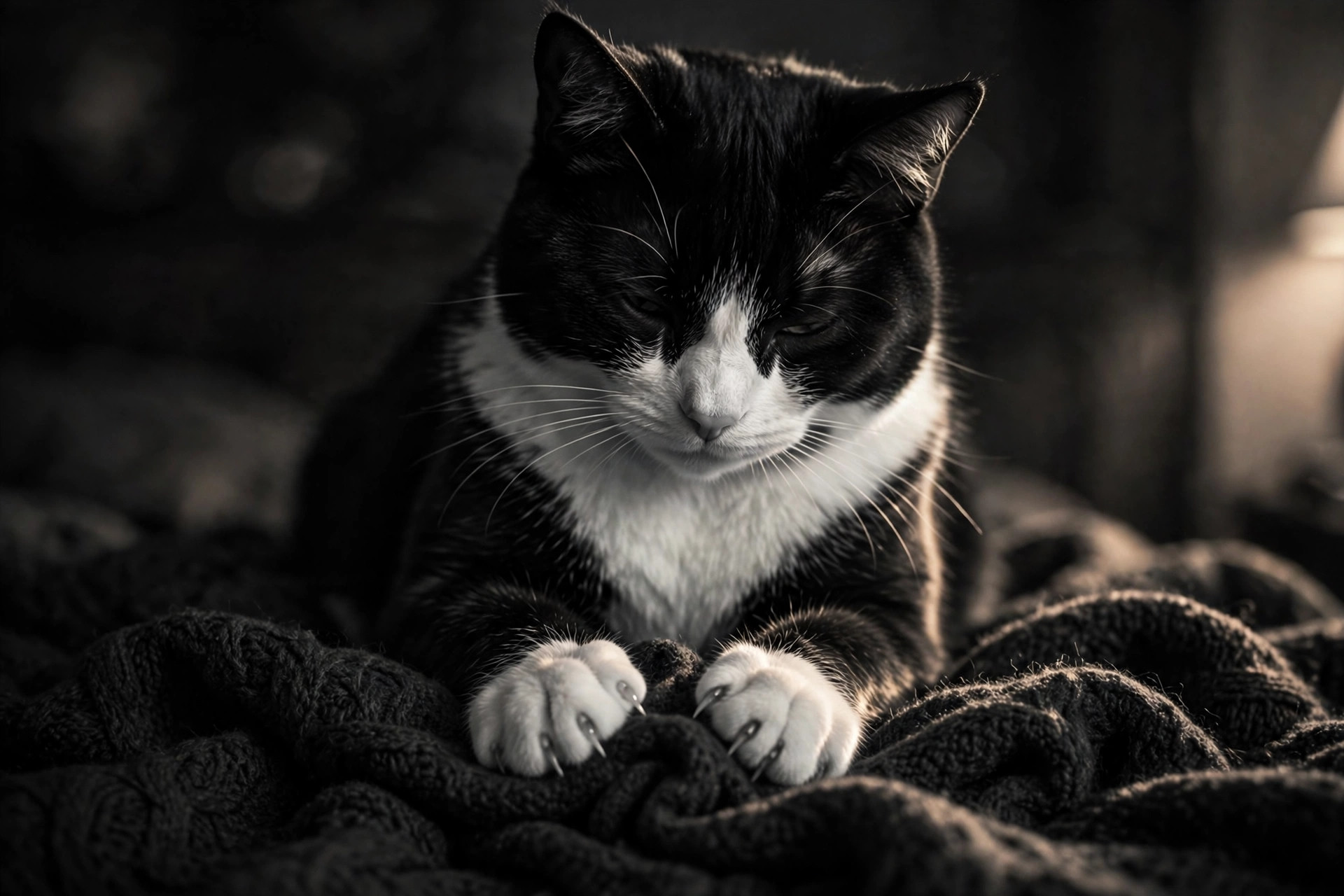
Every evening, at approximately the same hour, Biscuit climbs onto the arm of the good armchair and begins to bake.
The left paw presses down. The right paw presses down. Left. Right. Left. Right. A slow, deliberate rhythm, claws sliding out just enough to catch the fabric, eyes sinking to half-mast, the purr rising underneath it all like the hum of an oven. If you have lived with a cat, you know this performance. The internet has named it, fondly, "making biscuits."
It is the most domestic ritual in the feline repertoire — and also one of the oldest. Kneading is older than your armchair and older than the species' contract with humans altogether. Decode it properly, and your cat's paws are telling you several things at once, in a language that began before your cat was weaned.
First, the official terminology
Humans have been reaching for bakery metaphors for generations, but the behavior has a proper zoological name too: "milk treading," a term coined by the zoologist Desmond Morris. The mechanics are specific — a rhythmic, alternating push-and-pull of the front paws against a soft surface, often accompanied by purring or drooling. Some cats keep their claws sheathed; others extend them and leave a constellation of tiny punctures in the upholstery — the price of admission.
The name "milk treading" gives away the first and deepest explanation. Every kitten is born knowing this dance. Pressed against its mother's belly, a newborn kneads the tissue around the mammary glands, and the kneading stimulates the flow of milk. "Kneading, or 'making biscuits,' is very similar to the movements that kittens make when they are nursing on their mother," explains Mikel Delgado, a cat behaviour specialist at Feline Minds. The association is laid down in the first weeks of life: knead, and warmth and food and safety follow.
Why adults never stopped
Here is the interesting question. Adult cats do not nurse. Nothing they knead will ever produce milk. So why does the bakery stay open?
The leading explanation is that kneading is a piece of kittenhood the cat simply kept. Susan Hazel, an associate professor of animal behaviour at the University of Adelaide, describes it as a leftover nursing behaviour: kittens tread their paws to stimulate milk flow, and the suckling and the pheromones around the mammary glands make it "a very pleasurable activity." Adult cats, particularly around people they trust or on especially soft surfaces, appear to be reaching back for that comfort. As the registered veterinary nurse Laura Watson of International Cat Care puts it, cats associate the treading motion with the safety they felt while nursing, and reproduce it where they feel safe now.
There is a parallel that should make you smile. According to the ASPCA, adult cats do not meow at each other — only at humans, the way kittens meow at their mothers. Your cat, kneading your lap and meowing for dinner, may essentially be treating you as a large, clumsy, but beloved parent. The staff has no objection to this arrangement.
The signature in the paws
But comfort is not the whole story. There is a second message being stamped into your armchair with every push of the paw, and it is written in scent.
Cats carry scent glands in their paw pads, and kneading presses those glands against whatever is underneath, depositing a faint chemical signature. As behaviourists describe it, this is territorial marking — but not the loud kind. Spraying is a billboard; kneading is a monogram. It says, quietly and chemically, that this cushion, this blanket, this human lap, belongs in this cat's world. It gives the territory a familiar smell, which is itself a comfort. The cat is not only soothing itself; it is signing its work.
The wild kitchen
There is a third thread, older still. Before cats were bakery staff, their ancestors slept outside — and PetMD's veterinary writers note that wild cats would tread down tall grass and leaves to fashion a soft sleeping spot, and possibly to check the ground for visitors hiding in the foliage. The evening knead on your duvet may carry an echo of that ancient housekeeping: press the grass flat, test the ground, make the bed.
Add a fourth function and the picture is complete. The rhythmic motion itself is soothing — Dr. Alejandro Caos, a veterinarian with The Vets, compares it to the way humans enjoy kneading dough when baking: the repetition releases tension. Biscuit, for the record, kneads, purrs, turns once, and falls asleep within ninety seconds. The bakery closes; the siesta begins.
Reading your cat's biscuits
Once you know the science, the paws become legible:
The drooler. Some cats drool while kneading — occasionally a full string of it onto your sleeve. Hazel notes that drooling, and sometimes even suckling the kneaded surface, is part of the nursing association. Translation: this cat has time-travelled back to kittenhood. Treat it as the compliment it is.
The claws-out baker. Painful, yes. But the claws are not aggression; they are simply how the paws work when the kneading gets enthusiastic. Never punish the behaviour — the scientific consensus is firm: kneading is an affiliative, positive act, and discouraging it costs you a piece of the bond.
The non-baker. Not every cat kneads, and the absence means nothing. As the animal behaviourist Kristyn Vitale of Oregon State University notes, cats that skip kneading show their bond in other ways — purring, rubbing, or simply sitting beside you. The bakery is one dialect of affection, not the only one.
The sudden change. The one honest exception: most kneading is comfort, but behaviourists note that injured cats will occasionally knead and purr as a self-soothing strategy. If a cat that never kneaded suddenly starts, or kneading arrives with hiding, appetite loss, or flinching, the paws are not the story — the vet is. A sudden behaviour change is a veterinary question, not a training one.
The royal protocol for staff
So you are the chosen surface. What does good staff do?
Provide the sacrificial blanket. A thick throw on your lap converts claws-out baking from a hazard into a ritual.
Trim, never declaw. Keep the claws blunt with regular trims. Declawing — the amputation of the last bone of each toe — is condemned by veterinary behaviourists, and kneading is emphatically not a reason to consider it. The paws stay whole; the furniture takes its chances.
Read the preference. Pay attention to what the cat wants during the ritual. Some want petting; some want talking; some want you to sit perfectly still and serve as a warm, breathing mattress. The cat is the baker. You are the countertop.
The Tyrant's Verdict
Biscuit finished his evening bake as this article was being written — left, right, left, right, a small sigh, asleep. Four behaviours, four million years, one armchair: the kitten calling for milk, the wildcat flattening grass, the territorialist signing its name, and the companion telling its staff that all is well.
The bakery metaphor turns out to be exactly right, only better than we knew. Your cat is not pretending to make bread. It is making something older than bread: a warm, soft, scented, safe place — and it made you part of the recipe.
The royal decree, in short
- The zoologist Desmond Morris coined "milk treading": newborn kittens knead the mammary area to stimulate milk flow — kneading is born in nursing (Mikel Delgado, Feline Minds).
- Adult cats kept it: a retained piece of kittenhood comfort, reproduced where the cat feels safe, especially with trusted humans (Susan Hazel, University of Adelaide; Laura Watson, International Cat Care).
- Every knead stamps a scent signature: glands in the paw pads deposit a quiet chemical mark. Spraying is a billboard; kneading is a monogram.
- The motion is self-soothing and ancient — rhythmic tension release (Dr. Alejandro Caos, The Vets) with echoes of wild ancestors treading grass into nests (PetMD).
- Never punish kneading; trim claws, never declaw. A sudden change in kneading paired with hiding or appetite loss is a vet question, not a training one.
Sources & further reading
- Inverse — "Why do cats knead? Experts explain the complex science of 'making biscuits'" (Mikel Delgado, Feline Minds): inverse.com
- Live Science — "Why do cats knead?" (Susan Hazel, University of Adelaide; Laura Watson, International Cat Care): livescience.com
- ScienceAlert — "Here's Why Cats Knead You With Their Paws, According to Science" (Desmond Morris' "milk treading", PetMD nest-treading, the ASPCA meow parallel): sciencealert.com
- Scientific American — "Why Do Cats Knead like They're Making Biscuits?" (Kristyn Vitale, Oregon State; paw scent glands; never punish): scientificamerican.com
- The Vets / Nasdaq — "Why Do Cats Knead Or 'Make Biscuits' On You?" (Dr. Alejandro Caos, DVM): nasdaq.com
Keep reading the Desk
The Cat on the Doorstep: What to Do When a Stray Chooses You
National Feral Cat Day is this Friday, 16 October. A lean cat has started appearing at your gate — how to read it, feed it, vet it, and decide what comes next, with the science of TNR and the kitten socialisation clock.
Read the story →
The Jump She Stopped Making: Reading the Quiet Signs of Arthritis in Your Cat
Tomorrow is World Arthritis Day. Radiographs show joint disease in 9 of 10 older cats — yet owners almost never notice. The seven quiet signs, the new monthly treatment, and the royal home protocol.
Read the story →
The Royal Shadow: Why Your Cat Follows You Everywhere
Your cat follows you to the bathroom and waits outside the door. Science finally explains the clingy cat — Oregon State's attachment study, the six signs devotion has tipped into separation anxiety, and the royal protocol for healthy alone time.
Read the story →