The Cat the Law Forgot: The Fight to Make Drivers Stop for Cats
On 26 October, Parliament debates e-petition 750612: should drivers have to stop and report hitting a cat? The 189,192-signature campaign, the 1988 law that leaves cats out, and the protocol every driver and owner should know.
On Monday 26 October, at six in the evening, in a committee room off Westminster Hall, a group of MPs will sit down to argue about a single question: when a car hits a cat, should the driver have to stop?
189,192 people say yes. That is the largest cat-welfare petition in British parliamentary history, and Parliament has agreed to debate it. The government's current answer, stated plainly, is no.
Biscuit is an indoor cat. His exposure to traffic consists of watching the street through glass with the distant concern of a monarch reviewing a troublesome province. But half his coat is black, and black vanishes under headlights — which is precisely the point at which this stops being a British legal curiosity and becomes something every cat owner should understand.
The list that doesn't include your cat
Section 170 of the Road Traffic Act 1988 requires a driver to stop and give their details — or report the incident to the police within 24 hours — when an accident injures certain animals. The animals on the list: horses, cattle, asses and mules, sheep, pigs, goats, and dogs.
Hit a dog and drive off, and you have committed an offence. Hit a cat, and the law asks nothing of you. Nothing at all.
Why? The government's explanation is that the listed animals were chosen as working animals rather than pets. The provision was drafted for a world of farm traffic and horse-drawn commerce, and cats — creatures of the sofa, the windowsill, the 5 a.m. corridor sprint — were never part of that world.
There is a footnote worth knowing. Rule 286 of the Highway Code advises drivers to report any collision involving an animal to the police and, where possible, to make enquiries to find and notify the owner of a domestic animal. It is good advice. But it is only advice — only the Road Traffic Act decides what counts as a criminal offence, and the Act does not include cats.
The numbers behind the petition
A 2022 Early Day Motion in Parliament cited Petplan data estimating that around 230,000 cats are hit by cars in Britain every year. The Blue Cross puts the toll at roughly 200,000 cats killed on the roads annually — alongside some 80,000 dogs. Not every struck cat dies at the scene; many survive the impact and need urgent veterinary treatment to live. An unreported collision is an owner who never finds out, a cat that suffers alone, and a family that simply stops waiting.
The campaign is led by CatsMatter, a feline welfare organisation based in Stourbridge, which also founded World Animal Road Accident Awareness Day — held each year on 10 October, a week ago as this goes to print.
The petition itself, e-petition 750612, calls on the government to "legislate to require drivers to stop, check and report any road collisions with cats if they're injured on the road, and hold drivers accountable if they fail to stop and report a collision involving a cat on the basis they left a cat to unnecessarily suffer." It closed on 17 June 2026 with 189,192 signatures — comfortably past the 100,000 needed to force a debate. This is not the first attempt: a petition on the same question was debated in Parliament on 9 January 2023. The government has said it currently has no plans to change the law.
CatsMatter's counter-argument is sharper than it looks. If the exclusion exists because the listed animals are working animals, then what about the farm cat — the barn mouser, the stable cat, the working animal in all but paperwork? The campaign argues the working-animal defence deserves closer scrutiny. And beneath the legal philosophy is a simpler public feeling: most of those 189,192 signatures belong to people who do not accept that a dog legally counts more than a cat.
Honesty requires the other side. Critics say such a law would be nearly unenforceable — cats are small, they dart, they cross at night, and proving a driver knew they had hit one is genuinely hard. There is a fair version of that objection, and it should be heard. But the royal court's view is this: a law does not have to be perfectly enforceable to matter. Sometimes its job is to say, on the record, that the cat counts — and to change what a decent driver does in the moment, which is the part that saves lives.
The protocol every driver and owner should know
Law or no law, here is what to do. Print it in your head; you may need it at the worst possible hour.
If you hit a cat: stop, if it is safe to do so. Check the animal — a cat that looks dead may be in shock. If it is alive, wrap it in a towel or jacket (an injured cat will bite, even a gentle one) and get it to the nearest vet immediately; vets will treat an injured stray and scan for a microchip, and the RSPCA's 24-hour line (0300 1234 999) takes emergency reports. Try to identify the owner — knock on nearby doors, post in local groups — and report the collision to the police. Highway Code Rule 286 asks this of you already. Do it whether or not the statute does.
If your cat goes missing and you fear the road: check the verges and hedges along nearby roads first, then call every vet clinic within a few miles — injured cats get carried in by strangers all the time. Make sure your microchip details are current, because a chip is how a struck cat gets a name back. In England, microchipping cats is the law by the time they are 20 weeks old; the chip only works if the registry has your real number.
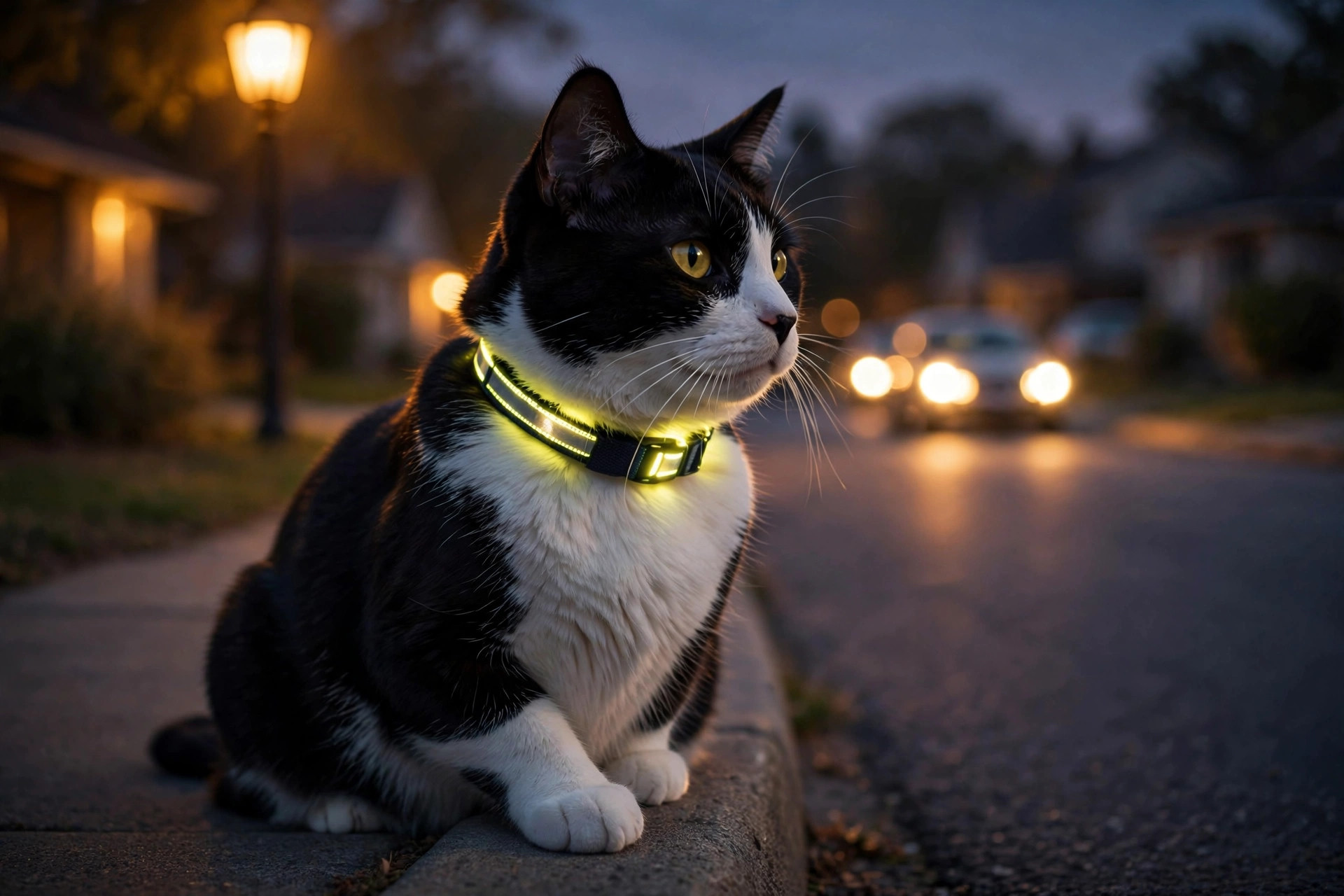
Prevention, the royal edition: a reflective breakaway collar makes a dark-coated cat visible in headlights — and never use a non-breakaway collar outdoors; the snag risk is real. Keep cats in at dusk and through the night, when traffic risk peaks and cats are hardest to see. Biscuit's black half disappears completely in a headlight beam, which the staff finds philosophically unacceptable. The reflective collar stays on. Royalty is visible.
The Tyrant's Verdict
Biscuit's official position, delivered from the windowsill: the law currently maintains that a collision with a mule is a matter for the police, and a collision with a cat is a matter for nobody. A mule is a fine animal. But the court notes that 189,192 people have now asked, in writing, whether that distinction still makes sense — and on 26 October, at 6 p.m., Parliament will finally have to answer them out loud. The debate will be streamed on the UK Parliament YouTube channel. The staff will be watching.
A cat is not livestock. It is not property in the way a fence is property. It is a family member that happens to weigh four kilos and disappear into the dark. The law can learn that. It learned dogs. Cats are next in line — 189,192 signatures long.
The royal decree, in short
- On 26 October 2026 at 6 p.m., MPs debate e-petition 750612 — 189,192 signatures, the largest cat-welfare petition in UK parliamentary history — calling for drivers to stop, check and report collisions with cats.
- Section 170 of the Road Traffic Act 1988 lists horses, cattle, asses and mules, sheep, pigs, goats and dogs. Cats are excluded — driving away after hitting a cat is not a criminal offence.
- The government's rationale: the listed animals were chosen as working animals, not pets. CatsMatter argues the farm cat is a working animal too, and the defence deserves scrutiny.
- Highway Code Rule 286 advises reporting animal collisions and notifying owners — but advice is not law.
- Around 230,000 cats are hit by cars in Britain every year (Petplan, via a 2022 Early Day Motion); the Blue Cross estimates ~200,000 cats killed annually.
- If you hit a cat: stop safely, check, towel-wrap an injured cat, nearest vet, microchip scan, find the owner, report to police. RSPCA emergency line: 0300 1234 999.
- Prevention: reflective breakaway collar, keep cats in at dusk and night, and keep microchip details current — chipping is mandatory in England by 20 weeks of age.
Questions the staff gets asked
Is it illegal to hit a cat and drive away in the UK?
Under Section 170 of the Road Traffic Act 1988, driving away after hitting a cat is not a criminal offence, because cats are not among the listed animals (horses, cattle, asses and mules, sheep, pigs, goats, dogs). Highway Code Rule 286 advises drivers to report animal collisions and notify owners, but that advice is not law.
When is the parliamentary debate on cat collision reporting?
Monday 26 October 2026 at 6 p.m. in Westminster Hall, debating e-petition 750612, which gathered 189,192 signatures — the largest cat-welfare petition in British parliamentary history. The debate is streamed on the UK Parliament YouTube channel.
What should I do if I hit a cat with my car?
Stop if it is safe to do so, and check the animal — a cat that looks dead may be in shock. Wrap an injured cat in a towel or jacket and take it to the nearest vet, who will treat it and scan for a microchip. Try to identify the owner, and report the collision to the police. The RSPCA's 24-hour emergency line is 0300 1234 999.
How many cats are hit by cars each year in the UK?
Petplan data cited in a 2022 Early Day Motion estimates around 230,000 cats are hit by cars in Britain every year. The Blue Cross estimates roughly 200,000 cats are killed on the roads annually.
Sources & further reading
- House of Commons Library — "E-petition debate: Requirement to report collisions with cats" (CBP-12220): commonslibrary.parliament.uk
- UK Parliament petitions — e-petition 750612, "Legislate to require drivers to report collisions with cats": petition.parliament.uk
- CatsMatter — feline welfare organisation behind the campaign: catsmatter.org
- Business Manchester — "Record Cat Welfare Petition Puts Road Collision Reporting Laws Under Parliamentary Scrutiny" (Oct 2026): businessmanchester.co.uk
- Business Lancashire — "New Evidence Challenges the Case for Excluding Cats from Road Collision Reporting Law" (Oct 2026): businesslancashire.co.uk
- Britbrief — reflective collars, microchip law, and the petition: britbrief.co.uk