The Healing Hum: The Real Science Inside Your Cat's Purr
Biscuit's purr runs at 25–30 Hz — inside the frequency window hospitals use to heal bone. The vocal-fold pads, the Minnesota heart study, and what the "healing purr" hype gets wrong.
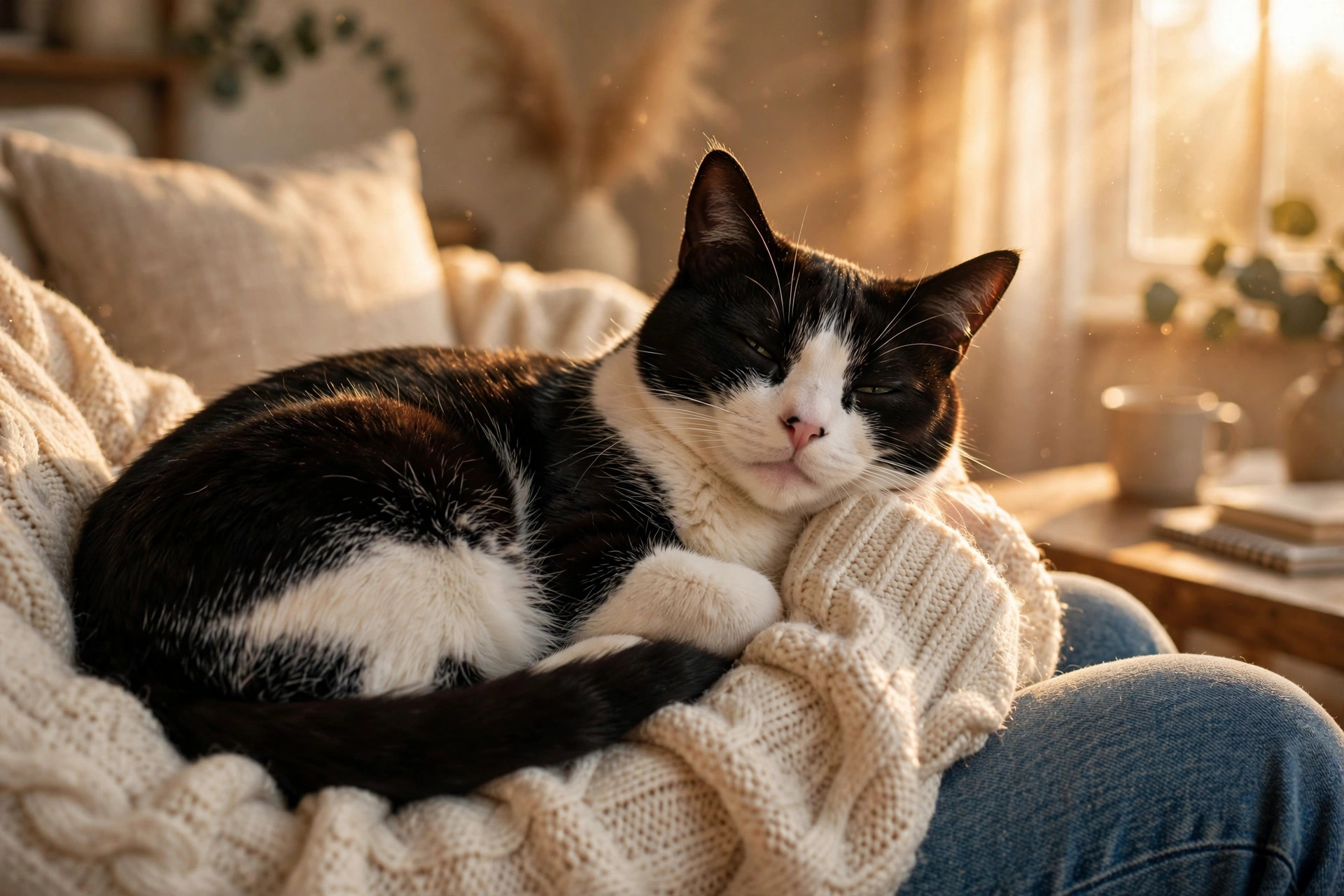
Biscuit has claimed the lap, and the lap is now humming. You can feel it before you hear it — a low, motorboat rumble that travels up through the thighs, into the ribs, and settles somewhere behind the sternum. The staff has been told, many times, that this sound heals. That a cat's purr repairs bones, lowers blood pressure, and possibly performs small acts of physiotherapy on the human it is sitting on.
The royal court does not believe in miracles. But it does believe in measurements, and the measurements on this one are genuinely strange. The purr really does sit inside a frequency band that medicine uses to heal tissue. The question is whether that is a coincidence, a conspiracy of physics, or something evolution actually built. Here is what the science says, and — just as importantly — what it does not.
A four-kilo animal making a sound no human bass singer can reach
The purr is acoustically absurd. A domestic cat weighs roughly four kilograms and carries vocal folds a few millimetres long, yet it produces a rumble in the 20–30 Hz range — below the lowest note of most human bass voices, down near the threshold where sound becomes vibration you feel rather than hear. By the ordinary rules of acoustics, small instruments make high sounds: a violin cannot do what a double bass does. The cat's purr has broken that rule for as long as humans have owned cats, and for fifty years nobody could say exactly how.
The textbook answer came from the 1970s: the "active muscle contraction" hypothesis. The cat, went the theory, fires its laryngeal muscles in rapid bursts — about thirty times a second — actively dilating and constricting the glottis, and that forced oscillation is the purr. Neural input required; constant brain involvement; an exceptional mechanism for an exceptional sound.
It was a good theory. Then, in October 2023, a team led by voice scientist Christian Herbst of the University of Vienna took it apart — using the larynges of eight deceased domestic cats, removed with the full consent of their owners after humane euthanasia for terminal disease.
They pinched the vocal folds together and pushed warm, humidified air through them. No brain. No nerves. No muscle contractions at all.
All eight larynges purred anyway.
The pad in the voice box
What the excised larynges produced, without any neural input whatsoever, was self-sustaining oscillation at 25–30 Hz — squarely inside the purring range of a living cat. The mechanism, the team reported in Current Biology, looks strikingly like the human "vocal fry": the creaky-voice register in which the vocal folds stay mostly closed and buzz in slow, pulselike cycles. No special neural machinery required — just airflow and tissue.
And the tissue is special. Anatomical investigation revealed connective-tissue "pads" embedded in the vocal folds, up to four millimetres across — dense masses that increase the effective vibrating mass and drag the oscillation frequency down, the way a thicker guitar string plays a lower note. Similar pads had already been found in lions and tigers, where they help produce earth-shaking roars. In the small cat, the same hardware appears to have been repurposed for the purr.
The researchers were careful to say the old theory is not dead — their data do not fully reject active muscle contraction, and living cats may well augment the passive oscillation with neural control. But the foundation has shifted. Purring looks less like a neurological trick and more like physics: a small animal exploiting aerodynamics the way every other vocalising mammal does, through self-sustained tissue oscillation. The exceptional mechanism, it turns out, was never exceptional at all.
The numbers, measured properly
How fast is a purr, exactly? Acoustic studies pin the fundamental down tightly. Robert Eklund and colleagues, measuring domestic cats, found fundamental frequencies of roughly 21–27 Hz on the exhale and 23–26 Hz on the inhale — cats purr in both directions, which is why the sound never pauses for breath. The fundamental hum sits around 25 Hz, but the purr is rich in harmonics that extend up to roughly 150 Hz, which is why it feels so full and textured against your lap.
The bigger cats complicate the picture in a telling way. Cheetahs purr too — at about 21 Hz exhale, 18 Hz inhale, a touch lower than the house cat. But lions, tigers, leopards and jaguars cannot purr at all: a strip of cartilage runs up their hyoid bones to the skull, locking the larynx in a configuration built for the full-throated roar — over a hundred decibels in one measured lion. It is a trade-off. You may roar, or you may purr. Nobody gets both.
The healing hypothesis — and where the evidence actually stops
Now the famous claim. It traces to bioacoustician Elizabeth von Muggenthaler of the Fauna Communications Research Institute, who recorded and analysed the purrs of 44 felids — domestic cats, ocelots, pumas, cheetahs, servals — and noticed something arresting. Every species, cheetah excepted, purred with strong frequency components at 25, 50, 100, 125 and 150 Hz. And those exact frequencies kept appearing in the medical literature as therapeutic: low-magnitude vibration in the 25–50 Hz range had been shown to stimulate bone formation in animal models (Rubin and colleagues, Nature, 2001 — trabecular bone density up 27% in sheep after a year of 30 Hz stimulation); 30 Hz vibration platforms increased bone mineral density in postmenopausal women (Gilsanz et al., Journal of Bone and Mineral Research, 2006); vibratory stimulation at 50–150 Hz was identified as the best frequency band for pain relief in musculoskeletal pain (Lundeberg, 1983). Von Muggenthaler, reviewing more than 40 studies, called the overlap "remarkable" and proposed that purring might be a low-energy self-healing mechanism — a way for a resting, energy-conserving predator to stimulate its muscles and bones without getting up.
This is where the royal court insists on precision. What von Muggenthaler demonstrated is a correspondence: purr frequencies overlap with frequencies that, delivered by machines in controlled doses, have therapeutic effects. What she did not demonstrate — and what no one has demonstrated — is that a cat purring on your lap repairs your bones. There has never been a randomised controlled trial of the healing purr. The frequencies match; the mechanism is plausible; the proof is absent. It is a hypothesis with excellent circumstantial evidence, which is precisely the category most internet "cat purr heals everything" posts should be filed under.
What is solid is that cats purr when they are hurt. They purr when injured, frightened, in pain, in labour, and dying. Contentment is only one entry on the list. That fact alone suggests the purr is doing something for the cat itself — self-soothing at minimum, and possibly the low-energy maintenance von Muggenthaler proposed. Evolution does not usually maintain expensive behaviour across every felid on the planet without a reason.
The urgent cry hidden inside the purr
Purring is also a social instrument, and the cats know it. In 2009, Karen McComb's team at Sussex published a study in Current Biology showing that cats deploy a special "solicitation purr" when they want food: they embed a high-frequency cry — acoustically similar to a human baby's cry — inside the low purr. Human listeners rated these purrs as more urgent and less pleasant, even when they had never owned a cat. Biscuit, it should be recorded, deploys this weapon at 5 a.m. with the precision of a siege engine.
And purrs carry identity. A 2025 study in Scientific Reports recorded 557 purrs from 21 cats and found that a purr encodes its owner's identity more strongly than a meow does — the researchers could correctly assign 76% of purrs to the right cat, well above chance. Your cat's purr is, in a measurable sense, a signature. The staff finds this both touching and slightly sinister.
The Minnesota heart study
The strongest human evidence that cats are good for the body comes not from frequencies but from epidemiology. In 2009, Dr Adnan Qureshi of the University of Minnesota's Stroke Institute published the results of a mortality follow-up of 4,435 American adults, drawn from the federal NHANES II survey and followed for roughly twenty years. After adjusting for age, sex, ethnicity, blood pressure, smoking, diabetes, cholesterol and body mass index, people who had ever owned a cat showed a relative risk of 0.63 for death from heart attack — about a one-third lower risk — compared with never-owners, with a similar trend for all cardiovascular death. Qureshi's proposed mechanism was disarmingly simple: pets relieve stress, and stress kills hearts.
The honest caveats travel with the headline. This is association, not causation: cat people may differ from non-cat people in ways no adjustment fully captures. But the signal survived rigorous confounder control, and it lines up with everything else we know about purring, petting, blood pressure and calm. The purr may or may not be a medical device. The cat, statistically speaking, appears to be good for the heart.
How to read the hum
A few royal decrees, for the staff's own safety. A relaxed, rhythmic purr from a loaf-shaped cat with half-mast eyes is the contentment purr — enjoy it; it is the entire point of the species. A purr from a cat that is hunched, hiding, off its food, or purring at the vet is the other purr — self-soothing, possibly pain. Context is the diagnosis, not the sound. And a purr that never stops, newly loud or newly constant in an older cat, is worth a vet visit, not a celebration.
Biscuit's purr, the court notes, shifts key with his agenda. The lap purr is 25 Hz of pure diplomacy. The 5 a.m. purr contains the baby-cry and an ultimatum. The staff has learned to read both. You learn the language of your own tyrant soon enough.
The Tyrant's Verdict
The purr is not magic. It is pads of tissue and pushed air, oscillating at the frequency of a slow heartbeat, rich enough in harmonics to reach the bands where medicine heals bone. Whether it heals you remains, strictly, unproven — but the cat purring through your ribs at 25 Hz is doing something measurable to your nervous system, and a Minnesota epidemiologist has the mortality data to show it matters.
Biscuit finished his lap session this morning, stood, stretched, and left without thanks. The hum faded. The sternum kept buzzing for a minute afterwards, like a struck bell.
The staff does not require a randomised controlled trial to know what that was. The court, however, insists on one anyway. Royalty deals in truth — and the truth is that this particular hum is the most interesting unsolved sound in the house.
The royal decree, in short
- A cat's purr is a 25–30 Hz rumble with harmonics up to ~150 Hz — far below what a four-kilo animal's vocal folds should produce.
- Herbst et al. (Current Biology, 2023): eight excised cat larynges purred at 25–30 Hz with no neural input at all, thanks to connective-tissue "pads" in the vocal folds — the mechanism resembles human vocal fry, not the old active-muscle-contraction theory.
- Lions and tigers cannot purr (cartilage in the hyoid locks the larynx for roaring); cheetahs purr at ~18–21 Hz but cannot roar.
- The healing hypothesis: purr frequencies (25–150 Hz) overlap with frequencies shown to stimulate bone growth (Rubin, Nature 2001) and relieve pain (Lundeberg, 1983) — but no clinical trial has ever tested the purr itself. Hypothesis, not therapy.
- Cats also purr in pain, fear, and labour — the purr is self-soothing, not just contentment. Context is the diagnosis.
- The Minnesota study (Qureshi et al., 4,435 adults, ~20-year follow-up): ever owning a cat was associated with a ~37% lower risk of death from heart attack (RR 0.63) — association, not proof, but the strongest human evidence yet.
- A 2025 study (Scientific Reports) found each cat's purr is an individual signature — 76% correctly assigned, more distinctive than meows.
Questions the staff gets asked
What frequency do cats purr at?
A domestic cat's purr has a fundamental frequency of roughly 21–27 Hz, with rich harmonics extending up to about 150 Hz. Cats purr on both the inhale and the exhale, which is why the sound never pauses for breath.
Can a cat's purr really heal bones?
Not proven. Cat purrs contain frequencies (25–150 Hz) that overlap with vibration frequencies shown to stimulate bone growth and relieve pain in controlled medical studies — but no randomised controlled trial has ever tested whether purring itself heals tissue. It is a promising hypothesis, not an established therapy.
Why does my cat purr when it is in pain?
Cats purr when injured, frightened, or ill, not only when content. Researchers believe this may be self-soothing behaviour — and possibly a low-energy way to stimulate muscles and bones during rest. Read the context: a hunched, hiding cat that is purring warrants a vet visit.
Do big cats like lions purr?
No. Lions, tigers, leopards and jaguars cannot purr: a strip of cartilage in their hyoid bones locks the larynx into a configuration built for roaring instead. Cheetahs can purr — but they cannot roar. You may roar, or you may purr; nobody gets both.
Sources & further reading
- Herbst CT et al., "Domestic cat larynges can produce purring frequencies without neural input" — Current Biology 2023 (abstract): medscape.com
- Science.org — "How do cats purr? New finding challenges long-held assumptions" (Oct 2023): science.org
- Smithsonian Magazine — "How Do Cats Purr? Scientists May Now Have an Answer" (Oct 2023): smithsonianmag.com
- Phys.org — "The cat larynx can produce purring sounds without cyclical neural input" (Oct 2023): phys.org
- Schötz & Eklund, "A comparative acoustic analysis of purring in four cats" (Fonetik 2011): roberteklund.info
- Elizabeth von Muggenthaler, "The felid purr: A healing mechanism?" — J. Acoust. Soc. Am. 2001 (Fauna Communications): thefreelibrary.com
- Medical News Today — "Cat owners have lower heart attack risk, study" (Qureshi, NHANES II follow-up): medicalnewstoday.com
- Qureshi et al., "Cat ownership and the Risk of Fatal Cardiovascular Diseases" — J. Vascular and Interventional Neurology 2009: researchgate.net
- "Meows encode less individual information than purrs" — Scientific Reports 2025: nature.com