The Royal Shadow: Why Your Cat Follows You Everywhere
Your cat follows you to the bathroom and waits outside the door. Science finally explains the clingy cat: Oregon State's attachment study, the six signs devotion has tipped into separation anxiety, and the royal protocol for healthy alone time.
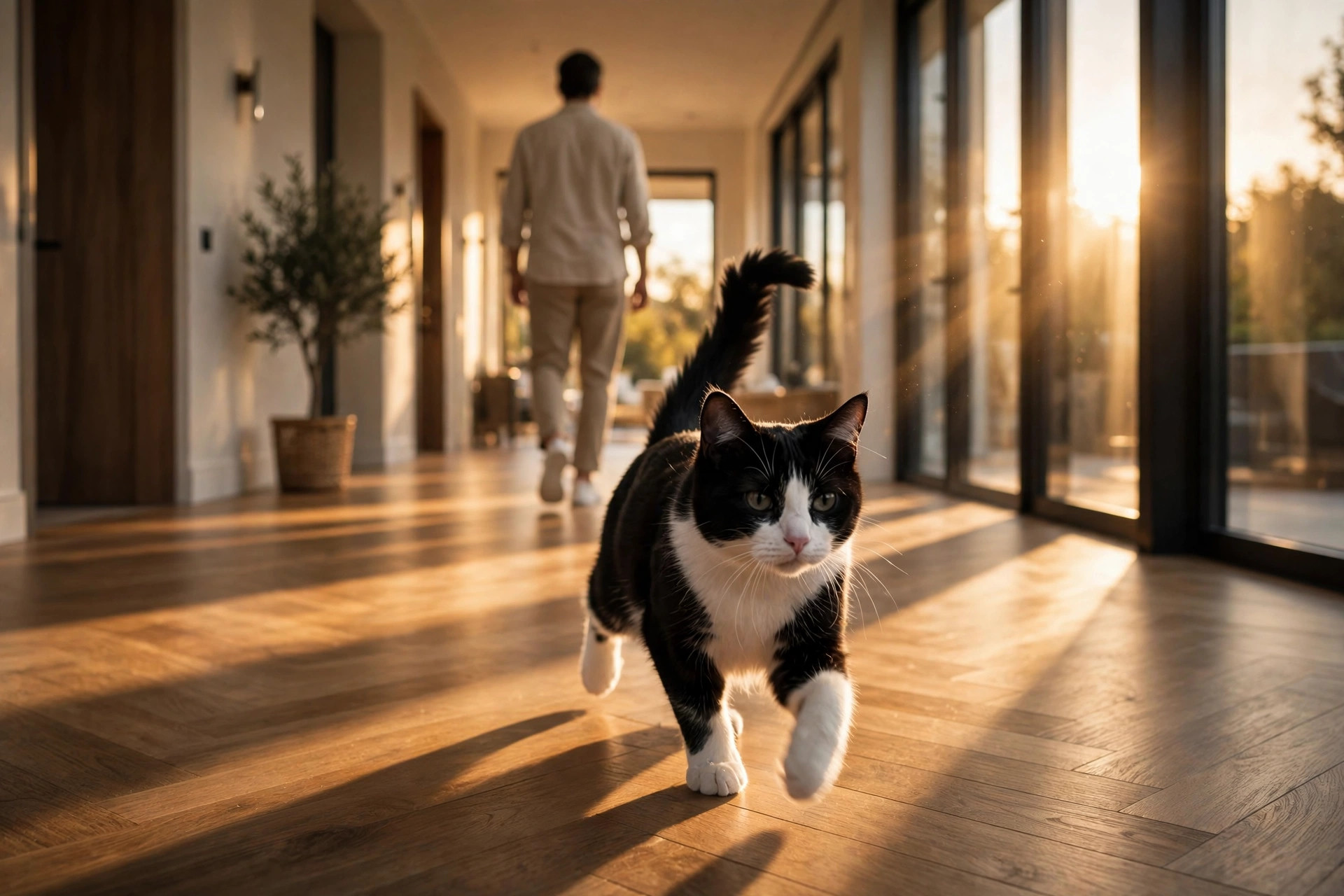
Biscuit has a schedule, and it is my schedule. I get up; he gets up. I make tea; he supervises the kettle from the counter, exactly where he is not supposed to be. I move to the study; he arrives one second later and occupies the warm spot on the chair I have just vacated. And when I head for the bathroom, he escorts me to the door, sits down with his paws aligned like a tiny footman, and waits. Not meowing. Not pawing at the door. Just standing guard, the way a royal bodyguard might — bored, loyal, and visibly judging me.
If you live with a cat, you know the shadow. The cat who follows you from room to room with no purpose and no destination. The cat who sits in the hallway watching you chop vegetables like it is theatre. The cat who has decided, without asking your opinion, that you require a full-time escort. Cats.com's most-read community threads this week ask exactly this — "Are Cats Possessive of Their Owners?" — and there is a reason the question keeps coming back: the clingy cat is one of the most misread animals on earth.
For decades, the cultural script said cats were aloof — that the following, the staring, the door-waiting was about food and nothing else. Science has now run the experiment, and the script was wrong. Your shadow is not plotting. He is attached.
The laboratory proved the bond
In 2019, researchers at Oregon State University did something nobody had bothered to do before: they ran the infant-attachment test — the one psychologists have used for decades on human babies and dogs — on cats. Dr. Kristyn Vitale and her colleagues put cats and kittens through a "secure base test": two minutes in an unfamiliar room with their caregiver, two minutes alone, then a two-minute reunion. Behaviour experts then scored how the animals behaved when the human returned.
The numbers were startling. Of the classifiable kittens, 64.3% were securely attached to their humans. The adults were nearly identical: 65.8% secure. Human infants, for comparison, test at about 65% secure attachment. Vitale's team found that securely attached cats, on reunion, calmed down and returned to relaxed exploration — using the human, as the researchers put it, as a source of comfort. Insecurely attached cats either clung excessively or avoided contact altogether.
Perhaps more remarkable: after a six-week socialisation and training course, the cats' attachment styles barely changed. "Once an attachment style has been established between the cat and its caregiver, it appears to remain relatively stable over time," Vitale said. Your cat's way of loving you is not a phase. It is a personality, set early and carried for life.
So when Biscuit follows me to the bathroom, he is not demanding anything. He is keeping his secure base in sight — the same thing a toddler does at the playground. The difference is that toddlers grow out of it. Cats, blessedly, do not.
Three reasons for the shadow
The following behaviour — what the internet calls the "clingy cat" — generally traces back to three motives, and learning to tell them apart matters.
One: you are the safe place. The attachment study explains the biggest share of it. A securely attached cat treats its human the way a child treats a trusted parent: someone to check in with, someone whose presence makes the world feel navigable. The cat that trots after you into every room is running a background programme — the safe thing is still there — and the programme refreshes constantly. This is not neediness. It is the biological machinery of a bond working exactly as designed.
Two: you are the interesting place. Cats are routine-driven territorial animals. You are the most dynamic event in the territory — you open doors, produce running water, manipulate mysterious containers, and occasionally drop food. The bathroom, in particular, is fascinating: running taps (many cats strongly prefer running water to still bowls), locked doors (unacceptable to a species that patrols a territory), and a human who is, for once, stationary and captive. Behaviourists note that much "clingy" behaviour is simple environmental monitoring plus the optimism that something good may happen. Biscuit's kettle supervision is, I am fairly certain, 90% attachment and 10% culinary surveillance.
Three: habit, learned and reinforced. Cats learn fast, and a cat that follows you gets rewarded constantly — attention, pets, treats, doors opened. The shadow is partly a trained behaviour, and the trainer was you. Every time you smiled at the little footman outside the bathroom door, you were running a training session.
When devotion tips into distress
Here is where the honest part begins, because the doctrine of this desk is zero misdirection: most clingy behaviour is healthy attachment, but some of it is a medical flag. Veterinary professionals are warning of a spike in feline separation anxiety this autumn, as return-to-office routines leave millions of cats home alone for longer stretches. According to the PDSA Animal Wellbeing Report, 58% of domestic cats are left alone for part of each day — and the longer, darker evenings mean more of those hours spent in an empty, quiet house.
Jimmy Bratley, veterinary adviser for Feliway, has named six warning signs that a cat's clinginess has crossed into genuine separation-related distress: excessive over-grooming (sometimes to the point of bald patches), heightened vocalisation especially near doors and windows, changes in litter tray habits, eating only when the owner is home, a diminished interest in play, and a new reluctance to go outdoors.
Other veterinary sources — WebMD and Ohio State University's Indoor Pet Initiative — describe the same family of symptoms: excessive crying and meowing, refusing food while the owner is away, urinating or defecating outside the litter box, vomiting, destructive behaviour, and over-the-top greetings on the owner's return. One study of 136 separation-anxiety cases recorded inappropriate urination as the most common sign, three-quarters of it aimed, poignantly, at the owner's bed.
The distinguishing line is this: a healthy shadow follows you while you are home. A distressed cat falls apart when you leave. If the cat is calm and playful in your presence but unravels in your absence — that is not devotion. That is anxiety, and it deserves a veterinary conversation, not a training trick.
The royal protocol for healthy alone time
For the healthy shadow, no intervention is needed — a cat that follows you around a lived-in house is a cat whose attachment system is working. But for the cat that struggles with your absence, behaviourists recommend a protocol that is essentially: make the house interesting, and make your departures boring.
The Ohio State Indoor Pet Initiative's guidance is admirably practical: window perches for watching the world, food puzzles that let the cat "hunt" for meals instead of eating from a bowl, food hidden around the house, a radio or TV left on your usual station, and at least ten minutes of genuine daily play. WebMD adds the behavioural layer: build up absences gradually rather than suddenly, keep arrivals and departures low-key — no emotional goodbyes, no ecstatic greetings — so the cat learns that comings and goings are unremarkable. Bratley and others note that pheromone diffusers and calming supplements can help, and that for severe cases a vet may discuss anti-anxiety medication — not as a sedative, but as a way to make behaviour modification possible. The condition is often lifelong, but it is manageable, and the earlier it is addressed the better.
Biscuit's protocol, for the record: he gets a food puzzle at breakfast, the radio on a talk station when the house is empty, and a strict rule that departures involve no drama — one pat, one sentence, out the door. He supervises the kettle. He guards the bathroom door. And when the house is quiet, the shadow simply naps in my chair, holding the warm spot. Attachment, it turns out, does not require your presence. Just the certainty that you will be back.
The Tyrant's Verdict
The clingy cat was always misjudged. He was never plotting, never scheming for food, never "too much." He was a creature running one of the oldest programmes in the mammalian brain: stay near the safe thing. Oregon State gave it a number — 65% secure, same as a human child — but the footman outside the bathroom door knew it all along.
So let the shadow follow. The escort to the bathroom is not surveillance. It is the highest honour a cat confers: you are the safe place, and I am not letting you out of my sight.
Unless the distress signs say otherwise. Then the safe place does what safe places do — and calls the vet.
Shadow questions, answered
Is it normal for my cat to follow me everywhere?
Yes. Oregon State University's 2019 secure-base study found about 65% of cats are securely attached to their humans — the same rate as human infants. Following you from room to room is how a securely attached cat keeps its safe base in sight.
Does a clingy cat have separation anxiety?
Not usually. A healthy cat shadows you while you are home. Separation anxiety shows in your absence: excessive vocalising near doors, over-grooming, litter tray changes, eating only when you are home, and loss of interest in play. If you see these signs, talk to your vet.
How can I help a clingy cat cope when I am away?
Enrich the house (window perches, food puzzles, hidden treats), leave the radio on, keep departures and arrivals low-key, build absences up gradually, and play at least ten minutes daily. For severe cases, your vet may discuss anti-anxiety support.
The royal decree, in short
- Your cat follows you because of attachment, not scheming — Oregon State's 2019 secure-base test (Vitale et al., Current Biology) found 64.3% of kittens and 65.8% of adult cats securely attached to their humans, matching the 65% rate of human infants.
- The shadow has three motives: you are the safe place (secure-base check-ins), you are the interesting place (running taps, locked doors, moving events), and learned habit — you trained the escort every time you smiled at it.
- The dividing line is presence vs. absence: a healthy shadow follows you around the house; a distressed cat falls apart when you leave.
- Six separation-anxiety warning signs (per Feliway vet adviser Jimmy Bratley): over-grooming, vocalising at doors/windows, litter tray changes, eating only when you are home, lost interest in play, reluctance to go outdoors.
- The royal protocol: food puzzles, window perches, radio on, low-key departures, gradual absences, 10 minutes of daily play — and the vet for anything severe. Often lifelong, but manageable.
Sources & further reading
- Oregon State University — "Cats, like children and dogs, develop attachments to their caregivers, study shows" (Vitale, Behnke & Udell, 2019, Current Biology): news.oregonstate.edu
- ScienceDaily — "Cats are securely bonded to their people, too": sciencedaily.com
- Brit Brief — "Six signs your cat is stressed" (Feliway vet adviser Jimmy Bratley; PDSA Animal Wellbeing Report, 58% of cats left alone daily): britbrief.co.uk
- WebMD — "Does Your Cat Have Separation Anxiety?": webmd.com
- Ohio State Indoor Pet Initiative — "Separation Anxiety": indoorpet.osu.edu
- Chewy — "How to Manage Cat Separation Anxiety": chewy.com
Keep reading the Desk
The Sudden Nip: Decoding Your Cat's "Love Bites"
Why does a happy cat suddenly bite mid-petting? A vet behaviorist's verdict on "love bites," the four warning signs you keep missing, and how to respond like staff instead of prey.
Read the story →
The Slow Blink: The Science Behind Your Cat's "I Love You"
Scientists at Sussex and Portsmouth proved the slow blink is real communication — two experiments, one shelter study, and how to blink back like royalty.
Read the story →
The 3 a.m. Grand Prix: The Real Science of the Zoomies
Your cat turns into a hallway rocket at 3 a.m. every night. The science behind the zoomies — four theories, one real term (FRAPs), and the night-peace protocol that actually works.
Read the story →