The Empty Corner: Your Cat's Sixth Sense, Explained
Biscuit stared at an empty corner for eleven minutes straight. He is not seeing ghosts — he is hearing ultrasonic gossip, seeing ultraviolet light, and reading the air with his whiskers. The science of the feline sixth sense.
✓ Every claim checked against published research — see Sources below.
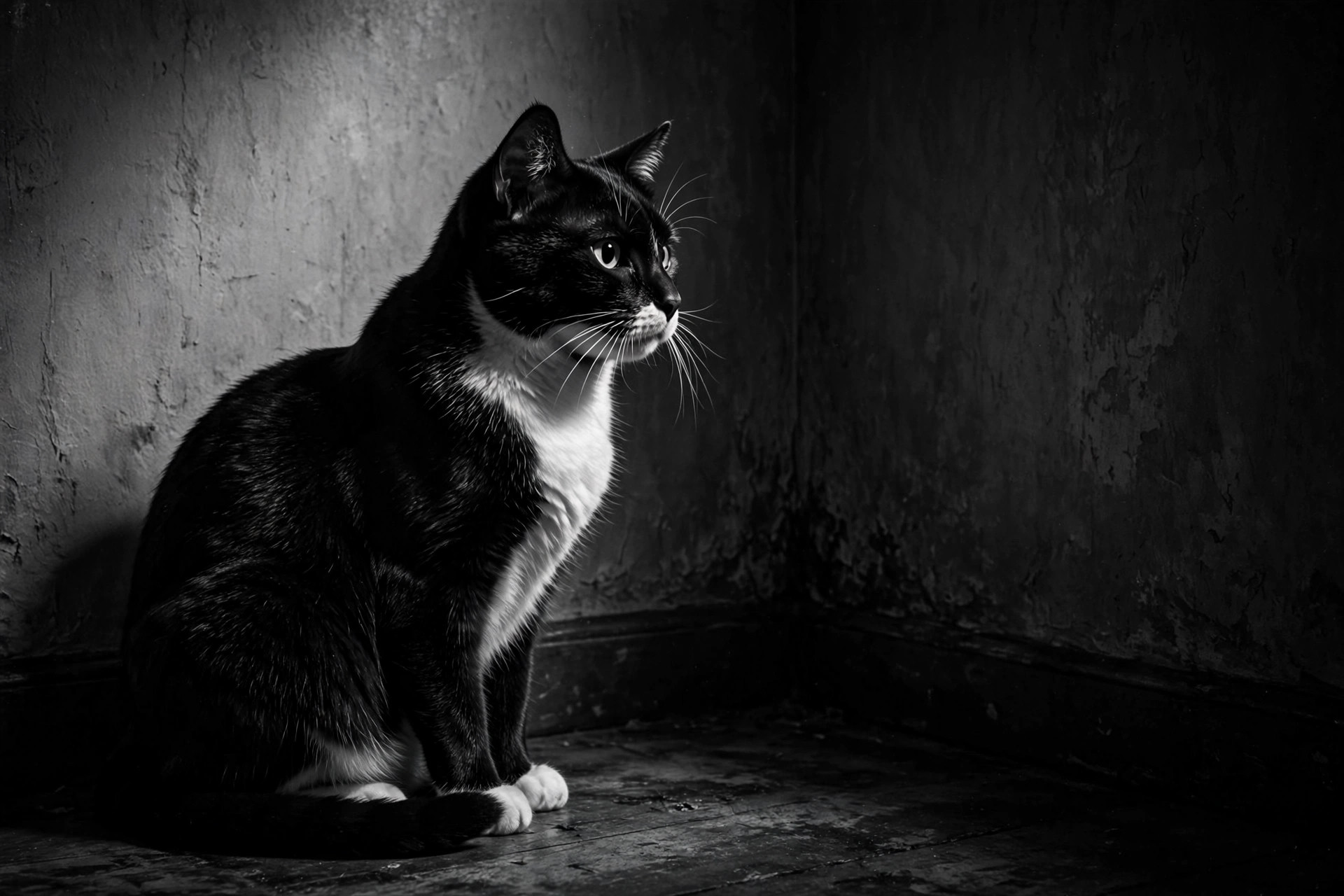
Biscuit has been staring at the corner for eleven minutes. Not the cat-flap corner, not the food corner — the empty corner, where two cream walls meet the skirting board and absolutely nothing has happened since the house was built. His pupils are dinner plates. His ears are doing slow, independent radar sweeps. Every few seconds his head tilts, as if the corner has whispered something worth considering.
It is mid-October, and the staff would like to say the season had nothing to do with it. The staff would be lying. With sixteen days to Halloween, a cat fixing an empty corner with that level of concentration invites exactly one question, and the staff asked it at 11.47 p.m., out loud, to an empty room: is he looking at a ghost?
The royal court does not believe in ghosts. But it does believe in evidence, and the evidence says something stranger: your cat is not staring at nothing. He is staring at a world your senses were never built to enter.
The ears that outrun physics
Start with the hearing, because it is the least mysterious and the most astonishing. Behavioural testing places a domestic cat's hearing range somewhere around 48 Hz at the bottom and 85 kHz at the top — deep into the ultrasonic, roughly four times the ceiling of human hearing, which gives up at about 20 kHz. Some references quote 55 Hz to 79 kHz; the exact edges move with the test, but every measurement lands in the same territory: a cat hears octaves that do not exist for you. A cat's most acute hearing sits between 500 Hz and 32 kHz — precisely the band where small prey makes its small, fatal noises.
The classic use of that reach, as consultants at the Cornell Feline Health Center have noted, is the very high-pitched sounds of kittens and prey species — the calls young mice make up around 40 kHz, a frequency your ears file under "silence."
Then add the hardware. Each ear carries roughly 30 muscles and can rotate 180 degrees independently, funnelling sound down to the middle ear like a satellite dish that swivels on its own mount. The result is a creature that can localise a sound three feet away to within a few inches — and that hears, in your quiet living room, an entire ultrasonic gossip column: the whine of a phone charger, the higher harmonics of the fridge compressor, a moth's wingbeat in the hallway.
So the first answer to the empty corner: it is not empty. It is loud.
The light you cannot see
The second answer arrived in 2014, when biologists Ron Douglas and Glen Jeffery did something wonderfully direct: they collected eyes from dead animals — donated by zoos, vets, and shelters — shone light through the lenses, and measured what came out the other side. Published in the Proceedings of the Royal Society B, the paper upended a century-old assumption. Most mammals, it turned out, do not have lenses like ours. Cats, dogs, ferrets, hedgehogs and okapis all let substantial ultraviolet light through to the retina.
Human lenses block UV — likely, Douglas suggests, to protect our high-resolution vision, since UV scatters and blurs. Cats traded the sharpness for the extra channel. What does that channel carry? Patterns on flowers that point pollinators to nectar. Urine trails glowing faintly along a rodent's route — a lit breadcrumb path to prey. A white rabbit visible in a snowstorm as something other than white-on-white.
The researchers' own suggestion was that this extra vision "might help explain their sometimes odd behavior." Your cat is not hallucinating. He is reading graffiti you cannot see, written in a colour your eyes were designed to miss.
The strobe in your living room
Now add motion, because a cat's vision is not just wider than yours — it is faster. In 1984, researchers Eysel and Burandt recorded from the cat visual system and found single neurons responding, with precise phase-locking, to the flicker of fluorescent tubes driven at mains frequency — modulation at 100 or 120 Hz, rates at which human observers see a perfectly steady glow. Some cat retinal cells had not even reached their critical flicker fusion frequency at those rates. The implication, repeated in vision references ever since, is that a television screen that looks continuous to you may read to a cat as a strobing light show.
That is the strobe. But the same system also detects movement you would swear was not there. A cat's eyes are tuned to the twitch — the dust mite, the fruit fly, the single hair drifting down through a shaft of afternoon light. What registers to you as an empty corner registers to him as a small theatre: motes spiralling, a spider testing a thread, the faint shimmer of heat off a radiator.
The antennae on the face
And then there are the whiskers — about twenty-four of them, twelve a side, arranged in four rows in a pattern as individual as a fingerprint, with smaller outposts above the eyes, on the chin, and on the backs of the forelegs.
A whisker is not a hair. Its root sits three times deeper than ordinary fur, sunk in a blood-filled sinus wrapped in a dense bundle of touch nerves; twitch the tip and the base fires a signal straight to the brain's tactile centres. As Dr Mia Richards of the University of Melbourne puts it: "It's all about vibration, airflow and touch."
Airflow. That is the word that matters for the empty corner. Whiskers detect the air itself moving — which is how a cat senses a wall in a pitch-dark room without touching it, how it judges whether a gap is jumpable, and how it reads the invisible weather of your house: the draft curling under the door, the convection current rising off the warm skirting board, the small pressure wave of something very small moving very quietly nearby.
Add the tapetum lucidum — the reflective layer behind the retina that gives cats their famous eyeshine — and the picture completes itself. In the dim corner of a dim room, where you see a wall, your cat sees ultraviolet markings, hears ultrasonic rustlings, watches strobing electronics, tracks drifting motes, and reads a map of air currents drawn across his whiskers like braille.
So what is he actually looking at?
Probably not a ghost. Probably one of these: a fruit fly doing laps in the corner's still air. A spider's footfall on the skirting board — ultrasonic to you, a dinner bell to him. The faint whine of a charger reflected off two walls. A dust mote spiralling down through the one shaft of light, tracked like a hawk tracks a thermal. Or the UV-bright smear where last week's moth left its chemical signature on the plaster.
He holds the stare because the stare is work. A cat fixing a point is a cat triangulating — ears swivelling, whiskers forward, pupils wide, the whole sensory array aimed at one coordinate like an observatory. The concentration you find spooky is, to him, Tuesday.
When the stare is news
One honest exception, because this desk does not do reassurance without a boundary. There is a difference between an alert stare — ears forward, whiskers out, body poised — and a cat that presses its head against a wall or a piece of furniture and holds it there. Persistent head-pressing is not a quirk; veterinary medicine treats it as a red flag that can signal neurological trouble, poisoning, or other serious conditions, and it warrants a prompt vet visit. Likewise, if the staring arrives suddenly alongside disorientation, circling, appetite loss, or any behaviour that is new for your cat, the sixth sense is not the story — the vet is.
Biscuit's corner-staring, for the record, has the ears of curiosity and the posture of a sports commentator. The court has logged it as normal.
The Tyrant's Verdict
Biscuit stared at the empty corner for eleven minutes, then sneezed at it — once, decisively — and walked to the kitchen for a snack. The corner, whatever it contained, had been dealt with.
That is the whole of the sixth sense: not magic, but equipment. Your cat lives in a richer room than you do — louder in the octaves above hearing, brighter in the colours below vision, busier with drafts and motes and whines you will never notice. He is not staring at nothing. He is staring at the part of the world that was reserved for him.
The ghost, in the end, was a fruit fly. It usually is.
The royal decree, in short
- Behavioural testing puts cat hearing around 48 Hz–85 kHz — roughly four times the human ceiling (~20 kHz) — most acute at 500 Hz–32 kHz, the band of small-prey noises; ~30 ear muscles per ear rotate 180° independently.
- Ron Douglas & Glen Jeffery (2014, Proceedings of the Royal Society B): cat lenses transmit UV light — urine trails, flower patterns, and other markings invisible to human eyes.
- Cat visual neurons track flicker at 100–120 Hz (Eysel & Burandt, 1984) — a "steady" TV screen or fluorescent tube may read as strobing to your cat.
- About 24 whiskers (twelve a side), roots 3× deeper than fur, wired to touch nerves — they read air currents, walls in the dark, and jumpable gaps.
- The corner stare is triangulation, not ghosts. Exception: persistent head-pressing against walls or furniture is a veterinary red flag — that is a vet visit, not a quirk.
Sources & further reading
- MyPets — "Cat's Hearing and Ears" (behavioural hearing range 48 Hz–85 kHz): mypets.net.au
- Phys.org — "Researchers find UV sensitivity in wide range of mammals" (Douglas & Jeffery, 2014): phys.org
- CNGBdb / Vision Research 1984 — Eysel & Burandt: "Fluorescent tube light evokes flicker responses in visual neurons": db.cngb.org
- The Free Dictionary — "Flicker fusion" (TV flicker and the cat's higher flicker-fusion rate): encyclopedia2.thefreedictionary.com
- University of Melbourne (Pursuit) — Dr Mia Richards: "Why a cat's whiskers are the bee's knees": pursuit.unimelb.edu.au
- PetPlace — "Structure and Function of the Whiskers in Cats" (~24 whiskers, 3× deeper roots): petplace.com
Keep reading the Desk

The Curse That Never Was: What October Gets Wrong About Black Cats
National Black Cat Day is Tuesday, 27 October. A tuxedo cat takes the medieval curse to pieces — shelter data, the Terrassa ban, and a survival guide for Halloween night.
Read the story →
The Royal Bakery: The Science of Why Cats Knead
Biscuit makes biscuits on the good armchair every evening. The real story of kneading — milk treading, paw-pad scent signatures, wild grass nests, and how to read your cat's paws.
Read the story →
The Cat on the Doorstep: What to Do When a Stray Chooses You
National Feral Cat Day is this Friday, 16 October. A lean cat has started appearing at your gate — how to read it, feed it, vet it, and decide what comes next, with the science of TNR and the kitten socialisation clock.
Read the story →